Ever added a splash too much vanilla extract or a pinch too much salt, only to wonder where the recipe went wrong? The answer is often hiding in plain sight — your spoon. Understanding spoon sizes isn’t just kitchen trivia; it’s the difference between a recipe that turns out perfectly and one that flops because of a measurement mistake.
From tiny demitasse spoons for espresso to hefty serving spoons for buffet lines, every spoon type has a job to do. In this guide, we’ll break down the most common types of spoon sizes, explain exact spoon measurements in both milliliters and inches, and help you understand which spoon belongs where — whether you’re baking, plating a formal dinner, or stocking a commercial kitchen.
By the end, you’ll know your teaspoon from your tablespoon, your dessert spoon from your dinner spoon, and exactly which spoon set you need for accurate, consistent results every time.
What Is a Spoon Size? (Quick Overview)
Before diving into the full list, it helps to understand that “spoon size” actually means two different things depending on context.
Volume-based sizing applies to measuring spoons. These are labeled by capacity — teaspoon, tablespoon, ½ teaspoon, and so on — and are designed to deliver a precise amount of liquid or dry ingredient, measured in milliliters (mL) or fluid ounces.
Length-based sizing applies to cutlery and serving spoons. These are measured in inches from tip to handle, and their size relates more to how the spoon is held and used at the table than to how much it holds.
There’s also a small but important wrinkle for American cooks: the US teaspoon (4.9 mL) is very slightly different from the UK teaspoon (about 5.9 mL in some older definitions) and the Australian teaspoon (20 mL tablespoon system). If you’re following an international recipe, this small gap in spoon measurements can actually shift your results, especially in baking where precision matters most.
Broadly speaking, all spoon types fall into three families:
- Measuring spoons — used for cooking and baking accuracy
- Cutlery spoons — used for eating at the table
- Specialty and serving spoons — used for specific foods, formal dining, or food-service portioning
Keeping these three categories in mind makes the rest of this guide much easier to follow.
Standard Measuring Spoons
When it comes to cooking and baking, accuracy makes all the difference — and that’s exactly where measuring spoons come in. Unlike cutlery, these tools are defined purely by volume, not shape or table etiquette. A good set of measuring spoons takes the guesswork out of recipes and keeps your results consistent every time you cook.
Teaspoon (tsp)
The teaspoon is the workhorse of the American kitchen. In the US, one teaspoon equals 4.93 mL, though it’s commonly rounded to 5 mL for everyday cooking. Physically, a measuring teaspoon is usually a small, rounded scoop about 5 to 6 inches long including the handle.
Common uses: measuring spices, vanilla or almond extract, baking powder, baking soda, and salt in small-batch recipes.
Because baking is a science, even a small teaspoon measurement error — like using a heaping teaspoon instead of a level one — can throw off the texture or rise of a finished product. Professional bakers almost always level off dry ingredients with a knife for consistency.
Tablespoon (Tbsp)
A tablespoon holds roughly 14.8 to 15 mL, which works out to exactly three teaspoons. It’s noticeably larger than a teaspoon, both in length (around 7 to 8 inches) and bowl depth.
Common uses: measuring oils, butter, sauces, dressings, and larger quantities of dry ingredients like flour or sugar in small recipes.
Tablespoons pull double duty in many American kitchens — the same spoon used to measure olive oil for a marinade is often the one used to serve a dollop of sour cream at the table. This dual purpose is part of why the word “tablespoon” refers to both a measuring tool and a cutlery item, which can sometimes cause confusion when following a recipe.
Other Sizes for Precision
Beyond the basic teaspoon and tablespoon, precise cooking often calls for smaller increments. These smaller spoon measurements matter most in baking, where ratios are unforgiving.
- ½ teaspoon (~2.5 mL): ideal for halving recipes or measuring strong spices like cayenne or cinnamon
- ¼ teaspoon (~1.25 mL): commonly used for baking soda, yeast, or potent extracts
- ⅛ teaspoon (~0.6 mL): used in very small-batch baking or delicate spice blending
- ½ tablespoon (~7.5 mL): useful when a recipe calls for an amount between a teaspoon and a full tablespoon
A complete measuring spoon set with all of these increments gives home cooks and professional chefs the flexibility to follow any recipe exactly as written.
Spoon Size Chart: Quick Comparison Table
For a fast, at-a-glance reference, here’s a spoon size chart covering the most common spoon types, their measurements, and their primary uses.
Spoon Size Chart — Quick Comparison Table
| Spoon Type | Volume (mL) | Length (inches) | Primary Use |
|---|---|---|---|
| Teaspoon | ~4.9 mL | 5–6 in | Spices, extracts, baking powder |
| Tablespoon | ~14.8–15 mL | 7–8 in | Oils, butter, sauces, dressings |
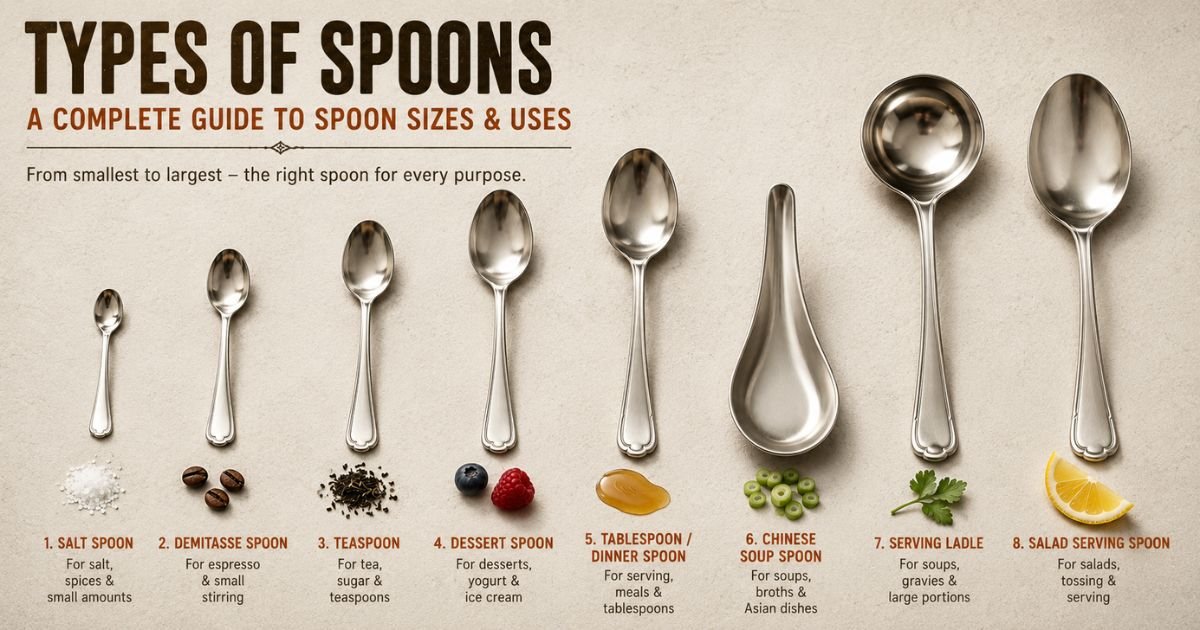
| Demitasse Spoon | Less than 5 mL | 3–4 in | Espresso, foam tasting |
| Dessert Spoon | ~10 mL | 6–7 in | Puddings, mousse, fruit salad |
| Dinner Spoon | ~15 mL | 7–8 in | Soups, stews, rice, cereal |
| Salt Spoon | ~1 mL | 2–3 in | Salt, spices, condiments |
| Chinese Soup Spoon | 15–30 mL | Short handle | Broths, noodles, dumplings |
| Serving Spoon | Varies | 8–15 in | Sides, entrees, buffet service |
Keep this table handy the next time you’re setting a table or restocking your kitchen drawer — it covers nearly every spoon type you’ll encounter in a typical American household or restaurant.
Types of Cooking Spoons and Their Sizes
Cooking spoons are a different animal entirely from cutlery. These spoon types are built for stirring, scooping, and plating during food prep — not for eating — and each one has design features suited to a specific kitchen task.
- Wooden spoon: A kitchen staple thanks to its non-conductive, non-scratch design. It won’t damage non-stick cookware and stays cool to the touch, even when stirring hot sauces for long periods.
- Slotted spoon: Features slots in the bowl that let liquid drain away while you lift out solid food, like boiled eggs or vegetables, from a hot pot.
- Bar spoon: A long-handled spoon with a small, twisted stem, designed for stirring cocktails and layering drinks. Bartenders favor metal versions for their weight and balance.
- Mixing spoon: Recognizable by its shallow bowl and thick curved edges, ideal for guiding batters, salsas, and sauces through a consistent blend.
- Basting spoon: Has a large, deep bowl for scooping marinades and pan juices, with a long handle that keeps your hand safely away from heat.
Case in point: A professional test kitchen once compared stirring risotto with a metal spoon versus a wooden spoon and found the wooden spoon produced a noticeably creamier texture — largely because it didn’t conduct heat away from the pan’s surface, allowing for more consistent simmering.
Common Cutlery Spoon Types & Sizes
Once you move from the stove to the table, cutlery spoons take over. These spoons are designed around comfort, portion size, and dining etiquette rather than volume precision.
Demitasse Spoon
The demitasse spoon is one of the smallest spoons you’ll find at a table setting, typically measuring just 3 to 4 inches long. It’s designed to fit inside a demitasse cup — the small cup used for espresso.
Common uses: stirring sugar into espresso, scooping foam off a cappuccino, and accompanying after-dinner coffee service in upscale American restaurants.
Dessert Spoon
Sitting between a teaspoon and tablespoon in size, a dessert spoon measures around 6 to 7 inches long with a capacity of roughly 10 mL. Its oval, slightly pointed bowl is designed for scooping soft desserts cleanly.
Common uses: pudding, mousse, fruit salad, cake, and ice cream.
In formal American dining etiquette, the dessert spoon is placed horizontally above the plate, or brought out fresh with the dessert course — a small but telling detail that separates casual dining from fine dining service.
Tablespoon / Dinner Spoon
The tablespoon, when used as cutlery rather than a measuring tool, doubles as the standard dinner spoon. At roughly 7 to 8 inches long and holding about 15 mL, it’s the most commonly used eating spoon in American households.
Common uses: soups, stews, rice, cereal, and general all-purpose eating.
Because this spoon shows up at nearly every meal, it’s often the first spoon replaced when a set wears out — which is why many manufacturers sell dinner spoons individually rather than only in full sets.
Other Common Spoon Types You Should Know
Beyond the everyday basics, several other spoon types show up regularly in American kitchens and restaurants, each solving a very specific eating challenge.
- Bouillon spoon: Has a round bowl (rather than oval) and short handle, ideal for sipping clear, broth-based soups.
- Japanese ramen spoon: Deep-bowled with a short handle, typically made of plastic or ceramic, designed for scooping broth and noodles together.
- Iced tea spoon: Recognizable by its unusually long handle, built to reach the bottom of a tall glass for stirring sugar into iced tea or sodas.
- Coffee spoon: Roughly teaspoon-sized, reserved for after-dinner coffee service in more formal settings.
- Grapefruit spoon: Has serrated edges and a pointed bowl, letting you separate citrus fruit from its rind without needing a separate knife.
- Spork: A spoon-fork hybrid, popular for outdoor dining, camping, and casual food service where a single utensil needs to do double duty.
- Caviar spoon: Small and shallow, traditionally made from mother-of-pearl, gold, or horn — materials chosen specifically because metal can alter the delicate flavor of caviar.
Specialty Spoons & Uses
Some spoon types exist purely to serve a niche purpose — often tied to formal dining traditions or specific global cuisines.
Salt Spoon
The salt spoon is tiny by design, typically just 2 to 3 inches long with a capacity of about 1 mL. Its short handle and oval bowl are built for controlled, precise portioning.
Common uses: serving coarse or flaked salt from an open salt cellar, most often seen in formal or fine-dining table settings.
Chinese Soup Spoon
Instantly recognizable, the Chinese soup spoon has a wide, flat-bottomed bowl and a short handle, holding between 15 and 30 mL. Unlike Western soup spoons, it’s designed to rest flat on a table or bowl rim between uses.
Common uses: broths, dumplings, and noodle soups across Chinese and broader Asian cuisine.
“The shape of a spoon isn’t decorative — it’s functional first. A Chinese soup spoon’s flat base exists because it needs to sit stable on a table between sips, unlike a Western spoon that’s typically rested on a saucer.” — a common observation among culinary instructors teaching Asian tableware traditions.
Serving, Salad, and Sauce Spoons
Larger serving spoons are essential for family-style meals, catered events, and buffet lines.
- Serving spoons typically range from 8 to 15 inches and handle sides, entrees, and grains.
- Salad spoons are often used in pairs (with a matching fork) to toss and serve greens without bruising delicate leaves.
- Sauce spoons feature a deeper bowl, built for controlled pouring of gravies and dressings without splashing.
Why Spoon Sizes Matter
Getting spoon sizes right isn’t just a matter of preference — it genuinely affects your cooking, health, and dining experience.
- Cooking accuracy: In baking especially, a single teaspoon too much baking soda can ruin an entire batch. Measuring spoons remove the guesswork.
- Nutrition and portioning: Using the correct spoon size keeps servings of sauces, dressings, and toppings consistent — which matters for calorie tracking and portion control.
- Dining etiquette: Different spoons serve different courses, from soup to dessert. Using the right one signals good manners and matches cultural dining expectations in formal American settings.
Even the smallest spoon on the table is doing real work — precision and etiquette both start with picking the right tool.
Spoon Sizes for Commercial Kitchens & Food Service
Restaurants and caterers face a different set of considerations than home cooks when choosing spoon sizes — durability, consistency, and compliance all come into play.
NSF certification matters for commercial flatware in the US, ensuring spoons meet food-safety and material standards for repeated commercial washing and use. Restaurants also rely heavily on portion-control spoons, sometimes called portion scoops, which are sized precisely (often labeled by scoop number) to keep food costs predictable and servings consistent across every plate.
When buying in bulk, food-service operators typically prioritize:
- Durability: stainless steel resists warping through thousands of dishwasher cycles
- Stackability: spoons that nest cleanly save valuable storage space in a busy kitchen
- Dishwasher safety: materials that hold up to commercial-grade heat and detergent
For a catering company plating hundreds of identical servings, a mismatched spoon set isn’t just an inconvenience — it directly affects food cost consistency and presentation quality across an entire event.
Choosing the Right Spoon Set
It’s worth repeating: measuring spoons and cutlery spoons are not interchangeable. A kitchen teaspoon might resemble a measuring teaspoon, but their actual volumes can differ enough to matter in a recipe.
When shopping for a new measuring spoon set, look for:
- ✅ Lab-tested accuracy — especially important for baking and dietary tracking
- ✅ A complete size range — ideally including ⅛ tsp, ¼ tsp, ½ tsp, 1 tsp, and 1 tbsp
- ✅ Clear, permanent markings — stamped or etched so labels don’t fade with washing
- ✅ Durable materials — stainless steel resists odor absorption; BPA-free plastic is lighter but should still be sturdy
For everyday cutlery, match the spoon to the meal: dessert spoons for lighter dishes, dinner spoons or tablespoons for soups and rice. But when a recipe calls for precision, always reach for a true measuring spoon rather than a cutlery substitute.
Frequently Asked Questions About Spoon Sizes
What are the different sizes of spoons?
Demitasse, teaspoon, dessert spoon, tablespoon, and large serving spoons.
What are the 5 types of measuring spoons?
¼ tsp, ½ tsp, 1 tsp, ½ tbsp, and 1 tbsp.
What are the four spoon sizes?
¼ tsp, ½ tsp, 1 teaspoon, and 1 tablespoon.
What are the 5 standard sizes in a set of measuring spoons?
⅛ tsp, ¼ tsp, ½ tsp, 1 tsp, and 1 tbsp.
What are the three different sizes of spoons?
Teaspoon, dessert spoon, and tablespoon cover most everyday needs.
What are the standard sizes of spoons?
Teaspoon (4.9 mL), dessert spoon (10 mL), and tablespoon (15 mL).
What are different types of spoons called?
Teaspoon, tablespoon, dessert spoon, demitasse, ladle, and serving spoon.
Conclusion
Spoon sizes might seem like a small detail, but they shape everything from how accurately you bake to how confidently you set a formal table. Whether you’re measuring baking soda with a teaspoon, plating a dessert spoon of mousse, or stocking a commercial kitchen with certified serving spoons, matching the right tool to the right task pays off in better results and a smoother cooking or dining experience.
Keep this guide bookmarked as your go-to spoon size chart, and next time a recipe or table setting calls for a specific spoon, you’ll know exactly which one to reach for.
15 common things that weigh 300 grams
16 common things that weigh 500 grams
22 common things that weigh 20 grams
15 common things that weigh 10 grams
20 common things that weigh 1 gram
18 common things that weigh 100 grams
20 common things that are 10 inches long
18 common things that are 16 inches long
14 common things that are 40 inches long
things that are 40 inches long
20 common things that are 15 inches long
18 common things that are 12 inches long
things that are 40 inches long
18 common things that are 7 inches long
18 common things that are 18 inches long
16 common things that are 4 inches long
20 common things that are 8 inches long
19 common things that are 3 inches long
15 common things that are 20 feet long
18 common things that are 13 inches long
17 common things that are 20 inches long
17 common things that are 6 inches long
17 common things that are 5 inches long
13 common things that are 2 inches long
20 common things that are 24 inches long
20 common things that are 30 inches long
20 common things that are 36 inches long
15 common things that are 59 inches long
20 common things that are 19 inches long
20 common things that are 26 inches long
20 common things that are 100 inches long
20 common things that are 9 inches long
20 common things that are 57 inches long
20 common things that are 34 inches long
20 common things that are 96 inches long
20 common things that are 5.7 inches long
20 common things that are 1.375 inches long
20 common things that are 1.25 inches long
25 common things that are 11 inches long
20 common things that are 1 inch long
20 common things that are 2.4 inches long
20 common things that are 2.75 inches long
20 things that are 102 inches long
20 common things that are 42 inches long
20 common things that are 55 inches long
15 Common Things That Weigh 12 Kg (2026 Real-World Comparisons)
20 Common Things That Weigh 15 kg — 2026 (Real-World Comparisons)
15 Common Things That Weigh 100 Kg (2026 Plus Exact Conversions)
20 Common Things That Weigh 30 kg — (2026 Real-World Comparisons)
15 Things That Weigh 70 Kg (2026 Real-World Comparisons)
15 Common Things That Weigh 25 kg – 2026 (Real-World Comparisons)
How Heavy Is 50kg? 10 Things That Match It Perfectly in 2026
How Heavy Is 40kg? 10 Things That Match It Perfectly in 2026
How Much Is 10kg? 15 Common Things That Weigh 10 Kilograms (2026)
How Heavy Is 20kg? 10 Things That Match It Perfectly in 2026
15 Things That Weigh 50 Ounces (Everyday Examples, 2026)
How Much Is 7 Ounces? 20 Most Common Things That Weigh About 7 Ounces
15 Common Things That Weigh 15 Ounces (With Real Life Examples)
20 Common Things That Weigh 10 Ounces (With Real Life Examples)
10 Common Things That Weigh 2 Ounces (With Pictures & Comparisons)
8 Common Things That Weigh 3 Ounces (With Real Life Examples)
15 Common Things That Are 30 Feet Long – 2026 (With Real-Life Comparisons)
15 Common Things That Are 300 Feet Long – 2026 (Real-Life Examples)
15 Common Things That Weigh 50 Lbs (50 Pounds) 2026 Everyday Objects
15 Common Things That Weigh 20 Lbs (With Everyday Comparisons)
15 Common Things That Weigh 10 Lbs (With Everyday Examples)
15 Common Things That Weigh 10 Pounds (2026)
15 Common Things That Are 50 Feet Long – 2026 (With Real-Life Comparisons)
How Far Is 500 Feet? 15 Most Common Things That Are 500 Feet Long
How Long Is 25 Feet? 20 Most Common Things That Are Exactly (or Super Close to) 25 Feet Long
20 Common Things That Are 44 cm Big (With Real-Life Examples)
20 Common Things That Are 2 cm Big (With Real-Life Examples)
20 Common Things That Are 5 cm Big: A Complete Size Guide
20 Common Things That Are 20 CM Big (With Inch Conversions)
20 Common Things That Are 30 cm Big (With Inch Conversions)
How Big Is A Centimeter? 18 Everyday Objects That Show You Exactly
Sig Fig Calculator: The Fast, Accurate Way to Count and Round Significant Figures
What Is Width? A Complete Guide to Understanding Width in Math and Everyday Life
How Long Until 3:15 PM? Live Timer Check the Exact Time Left Instantly
20 Common Things That Are 10 Meters Long (With Visual Comparisons)
20 Common Things That Are 3 Meters Long (With Easy Comparisons)
How Far Is 500 m Really? 20 Famous Things & Everyday Distances That Equal About 500 Meters Long
How Long Is 20 Meters In Comparison To 20 Everyday Objects
How Long is 30 Meters? 25 Most Common Distances And Things That Are 30 Meters Long -2026
20 Common Things That Are 2 Meters Long/Tall (2026)
How Long Is 100 Meters? 15 Common Things That Are 100 Meters Long
How Long Is 5 Meters? 15 Common Things That Are 5 Meters Long
How Long Is 50 Meters? 15 Common Things That Are 50 Meters Long
How Long Is 4 Meters? 15 Common Things That Are 4 Meters Long
How Long Is 300 Meters? 15 Common Things That Are 300 Meters Long
Karen Backfisch-Olufsen: The Story of Jim Cramer’s Ex-Wife
Amy Sherrill: The Real Story Behind Tim Duncan’s Ex-Wife
Mary Carey Van Dyke: The Story Behind Barry Van Dyke’s Wife
Matthew Mario Rivera: The Story Behind Kasie Hunt’s Husband
Constantine Yankoglu: The Story of Patricia Heaton’s First Marriage
Gatorade Bottle Dimensions: A Complete Guide With Facts
Arizona Tea Can Dimensions: Size, Height & Width Guide With Facts
How Long Is 5 Inches? 20 Everyday Objects That Are 5 Inches Long With Pictures
How Long Is 7 Inches? 20 Common Things That Are 7 Inches Long
20 Common Things That Measure 50 Feet Long or Big With Pics
How Long Is 2 Feet? 12 Common Things That Are 2 Feet Long With Pics
How Long Until 3 PM? The Ultimate Live Countdown Guide
Paula Ebben Age 2026: Husband, Family, Networth Bio and Secrets
Lolo Wood Net Worth: Age, Height, Career, Ridiculousness, Wild N Out & Motherhood (2026)
Dino Guilmette: A Deep Dive Into His Life, Career, and Personal Story
BigXthaPlug Age: His Net Worth, Height, Weight, and Life Story
Who Is Jeremy Yaffe? The Quiet Life Behind Alan Arkin’s Early Years
Pringles Can Dimensions: Size, Height & Diameter In Detailed 2026
Metric Socket Sizes Chart & Conversion Guide 2026
Metric Socket Sizes Chart & Conversion Guide In Detailed 2026
Per Stay Vs Per Night: Which Accommodation Pricing Option Is Cost-Effective?
How Tall Is the iPhone 16 in cm? (Official Size Guide) In Detailed
2×8 Actual Size: 1.5 in × 7.25 in (38 mm × 184 mm) — The Complete Guide
Lauren Compton: Early Life, Background, Wikipedia, Grokipedia, and Career (2026)
Brandi Belle: IMDb Profile, Early Life, Career, Personal Life and Grokipedia Guide
Matte Babel Wikipedia: Net Worth, Kids, Early Life, and Grokipedia Facts
Velicity Von: Early Life, Net Worth, Career, and Her Grokipedia Profile
What Is Erikkapost Com? The Honest Guide to Features, Pros and How It Works in 2026 Magazine Aura
SFM Compile: A Comprehensive Overview of Source Filmmaker Model Compilation (2026) Magazine Aura
How Long Until 2 PM? Live Countdown, Time Zones, and Manual Calculation Explained
How Long Until 3:30 PM? Live Countdown Timer, Calculator & Complete Guide
How Long Until 2:30 PM? Live Countdown Timer
How Long Until 2:30 PM? See Live Now
What Time Was It 15 Hours Ago? Live Countdown
What Time Was It 11 Hours Ago? Live Countdown & Instant Time Calculator
King Size Bed Dimensions: The Complete Size Guide
Everything You Need to Know About Crayola Air Dry Clay: A Complete Guide
Joylette Goble: The Untold Story of Katherine Johnson’s Daughter
Sharon Mobley Stow: The Untold Story of Jim Acosta’s Ex-Wife

Hi, I’m John Wick, the admin at Magazineaura.com. I make measurements simple and easy to understand, from bed sizes to everyday length conversions. Clear guides. Accurate dimensions. No confusion.