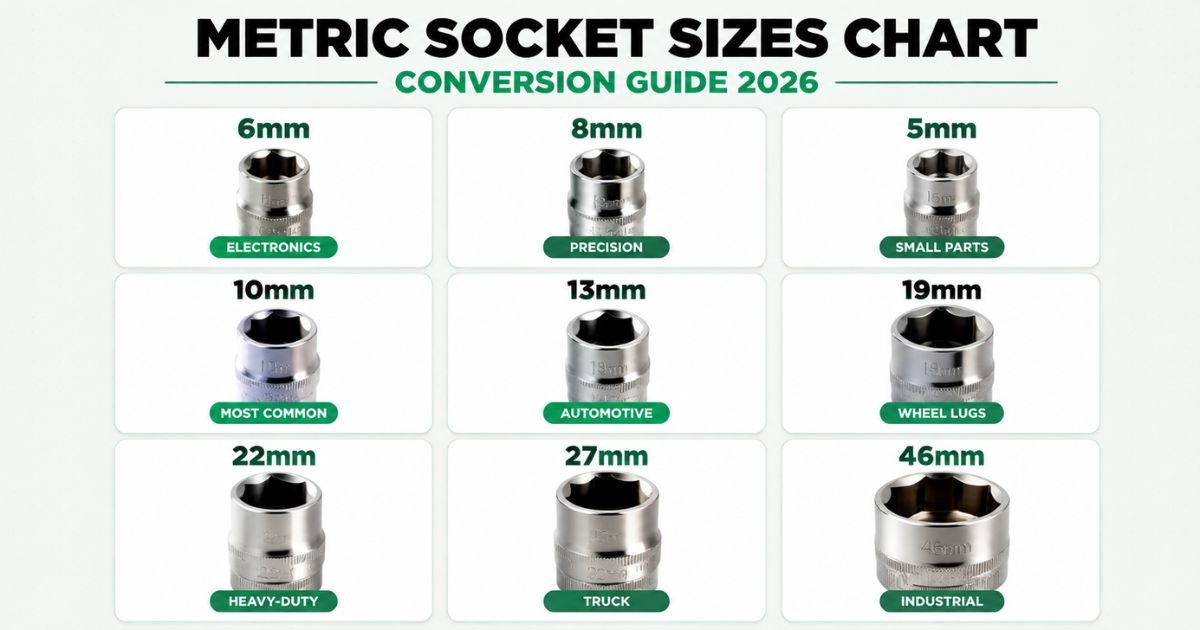
Metric socket sizes range from tiny 4mm sockets built for electronics up to massive 50mm+ sockets used on heavy machinery. This guide lays out the complete metric socket sizes chart, the closest SAE equivalents for each size, and which pairings are safe to substitute. Every size below includes the real bolt heads and everyday tools it fits, so you always grab the right socket the first time.
Metric to Standard Socket Conversion at a Glance
Before the full breakdown, here’s the fast answer for the sizes people search most.
10mm ≈ 3/8″, 13mm ≈ 1/2″, 14mm ≈ 9/16″, 17mm ≈ 11/16″, and 19mm ≈ 3/4″ are the closest common SAE pairings. None of these match exactly, so use them only as emergency substitutes and never as a permanent swap on a torqued bolt.
Complete Metric Socket Sizes List by Category
Here’s every size this guide covers, grouped by where you’ll actually use it.
- Precision & Electronics: 4mm, 4.5mm, 5mm, 5.5mm, 6mm, 7mm, 8mm
- Everyday Automotive & DIY: 9mm, 10mm, 11mm, 12mm, 13mm, 14mm, 15mm, 16mm, 17mm, 18mm, 19mm
- Heavy-Duty & Industrial: 20mm, 21mm, 22mm, 24mm, 27mm, 30mm, 32mm, 36mm, 41mm, 46mm, 50mm
Precision & Electronics Metric Socket Sizes (4mm–8mm)
These small metric socket sizes handle delicate work where torque matters less than fit.
4mm Socket
A 4mm socket measures 0.157 inches across the flats, making it one of the smallest sizes in a standard metric socket set. It’s closest to a 5/32-inch SAE socket, a pairing tight enough to use safely in a pinch.
Technicians reach for a 4mm socket on small electronics housings, RC hobby builds, and miniature appliance hardware. A 1/4-inch drive ratchet is the standard match for this size.
4.5mm Socket
The 4.5mm socket sits at 0.177 inches, a half-size found mainly in European and Asian equipment. No SAE size lines up closely enough to substitute safely here.
This size shows up on small appliance panels and compact machinery built to tighter metric tolerances. Most basic sets skip it, so it’s usually found only in extended metric socket sets.
5mm Socket
A 5mm socket measures 0.197 inches across the flats and covers general small-fastener work. Like the 4.5mm, it has no reliable SAE equivalent close enough for safe substitution.
Bicycle components, furniture hardware, and small electronics all commonly use 5mm bolts. IKEA flat-pack furniture assembly frequently calls for this exact socket size.
5.5mm Socket
The 5.5mm socket comes in at 0.217 inches and pairs closely with a 7/32-inch SAE socket. This is one of the tighter metric-to-SAE matches in the small-size range.
Small engine components and compact machinery fasteners commonly use this size. It’s a common but often overlooked size in basic metric socket sets.
6mm Socket
A 6mm socket measures 0.236 inches across the flats, corresponding to the hex head on M4 bolts. It sits between 1/4-inch and 9/32-inch SAE, without a tight match to either.
This size is a staple for furniture assembly, bicycle parts, and general light fasteners. IKEA and other flat-pack furniture brands rely heavily on 6mm hardware.
7mm Socket
The 7mm socket checks in at 0.276 inches and matches the hex head on some M4 bolt variants. Its closest SAE neighbor is 9/32 inch, though the fit is loose.
Motorcycle panels, light machinery, and bicycle components frequently use 7mm fasteners. A 1/4-inch drive ratchet handles this size comfortably.
8mm Socket
An 8mm socket measures 0.315 inches and lines up closely with a 5/16-inch SAE socket, one of the safer swap pairs on this chart. It also matches the hex head on M5 bolts.
This size covers interior trim panels, brackets, and small appliance hardware across most vehicles. Both 1/4-inch and 3/8-inch drive sockets are made in this size.
Everyday Automotive & DIY Metric Socket Sizes (9mm–19mm)
This workhorse range of metric socket sizes covers roughly 80% of automotive and household repair jobs.
9mm Socket
A 9mm socket measures 0.354 inches across the flats and sits between 11/32-inch and 3/8-inch SAE without matching either safely. It’s one of the sizes with no reliable standard substitute.
Motorcycle engines and general machinery commonly call for a 9mm socket. Keeping the correct metric size on hand avoids rounding these fasteners under torque.
10mm Socket
The 10mm socket is the most reached-for size in any metric socket set, measuring 0.394 inches across the flats. It’s closest to 3/8-inch SAE, though nearly 19 thousandths of an inch larger.
This size fits the hex head on M6 bolts, found throughout engine bays, brackets, and interior panels. Mechanics often joke that the 10mm socket is the first one to go missing from any toolbox.
11mm Socket
An 11mm socket measures 0.433 inches and pairs closely with a 7/16-inch SAE socket, one of the tightest matches on this chart. The gap is small enough that some mechanics use them interchangeably in light-duty work.
General automotive and motorcycle fasteners commonly use this size. A 3/8-inch drive ratchet is the standard fit for an 11mm socket.
12mm Socket
The 12mm socket comes in at 0.472 inches, closest to a 15/32-inch SAE size rather than the more commonly stocked 1/2-inch. That distinction matters, since 1/2-inch is nearly 28 thousandths off.
This size fits some M8 bolt head variants and general automotive hardware. Because the closest SAE match isn’t a commonly stocked size, sticking with the metric socket is the safer choice.
13mm Socket
A 13mm socket measures 0.512 inches and is the standard size for M8 hex bolt heads. Its closest SAE neighbor is 1/2 inch, off by roughly 12 thousandths of an inch.
Spark plugs, engine covers, and general automotive hardware all commonly use a 13mm socket. It’s considered one of the essential sizes in any metric socket set.
14mm Socket
The 14mm socket checks in at 0.551 inches, closest to a 9/16-inch SAE socket with about an 11-thousandth gap. This size corresponds to several M9 and M10 bolt head variants.
Suspension bolts, brake calipers, and engine fasteners frequently call for a 14mm socket. It’s a common size on both domestic and import vehicles.
15mm Socket
A 15mm socket measures 0.591 inches across the flats and sits closest to a 19/32-inch SAE size, a fraction most basic sets don’t include. This makes the 15mm socket harder to substitute in a pinch.
Engine components and general machinery use this size less often than 13mm or 14mm. Still, professional metric socket sets typically include it for completeness.
16mm Socket
The 16mm socket measures 0.630 inches and pairs closely with a 5/8-inch SAE socket, off by about 5 thousandths of an inch. That’s a tight enough gap for light-duty substitution.
Spark plug sockets and some M10 bolt heads commonly use this size. Many Honda and Toyota engines call for a 16mm spark plug socket specifically.
17mm Socket
A 17mm socket measures 0.669 inches and is the standard size for M10 hex bolt heads. Its closest SAE match, 11/16 inch, sits about 18 thousandths off.
Wheel lug nuts and brake hardware frequently use a 17mm socket on many vehicles. It’s one of the most commonly stocked sizes in any metric socket set.
18mm Socket
The 18mm socket checks in at 0.709 inches and is used on some M11 bolt heads and drain plugs. Its closest SAE neighbor, 11/16 inch, is actually smaller by about 21 thousandths.
Oil drain plugs and general engine hardware commonly use this size. It sits between the more frequently used 17mm and 19mm sockets in most sets.
19mm Socket
A 19mm socket measures 0.748 inches, making it nearly identical to a 3/4-inch SAE socket with only about 2 thousandths of an inch difference. This is one of the closest metric-to-SAE matches available.
This size fits M12 bolt heads and is one of the most common wheel lug nut sizes on passenger vehicles. It’s considered a core size in every metric socket set.
Heavy-Duty & Industrial Metric Socket Sizes (20mm–50mm)
Beyond 19mm, metric socket sizes move into truck, axle, and heavy machinery territory.
20mm Socket
The 20mm socket measures 0.787 inches across the flats and sits closest to a 25/32-inch SAE size, a fraction rarely stocked in standard sets. This makes the metric size the more practical choice.
Heavy automotive and general machinery fasteners commonly use a 20mm socket. It marks the point where sets typically shift to 1/2-inch drive tools.
21mm Socket
A 21mm socket measures 0.827 inches and has no safe SAE substitute close enough for torqued work. This size sits between the more common 13/16-inch and 7/8-inch SAE sizes.
Wheel lug nuts on many European vehicles specifically require a 21mm socket. Because there’s no reliable substitute, this size belongs in every automotive metric socket set.
22mm Socket
The 22mm socket checks in at 0.866 inches and fits M14 bolt heads. It’s another size on this chart with no safe SAE equivalent for torqued fasteners.
Oxygen sensors and spark plug applications commonly call for a 22mm socket. Many trucks and larger sedans also use this size for wheel lug nuts.
24mm Socket
A 24mm socket measures 0.945 inches across the flats and fits M16 bolt heads. Like 21mm and 22mm, it has no close SAE substitute suitable for torqued work.
Axle nuts and larger truck hardware frequently require a 24mm socket. It’s a standard size in heavy-duty and truck-focused metric socket sets.
27mm Socket
The 27mm socket measures 1.063 inches and is one of the closer metric-to-SAE matches at this size, sitting near 1-1/16-inch SAE. It corresponds to M18 bolt heads.
Heavy truck hardware and larger machinery fasteners commonly use this size. A 1/2-inch or 3/4-inch drive ratchet is typically needed for the torque involved.
30mm Socket
A 30mm socket checks in at 1.181 inches and fits M20 bolt heads on heavy equipment. Its closest SAE neighbor, 1-3/16 inch, is close but not exact enough for torqued fasteners.
Industrial machinery and larger suspension components frequently require a 30mm socket. This size marks the upper range of most general-purpose metric socket sets.
32mm Socket
The 32mm socket measures 1.260 inches and fits M22 bolt heads on heavy-duty equipment. Its closest SAE match sits at 1-1/4 inch, about 10 thousandths off.
Larger suspension bolts and industrial fasteners commonly use this size. It typically requires a 1/2-inch or 3/4-inch drive tool to handle the torque involved.
36mm Socket
A 36mm socket measures 1.417 inches across the flats and fits M24 bolt heads. This size falls outside most standard automotive sets and into specialty territory.
Heavy machinery and large structural bolts commonly call for a 36mm socket. Commercial vehicle mechanics keep this size on hand for axle and suspension work.
41mm Socket
The 41mm socket checks in at 1.614 inches and is used almost exclusively on heavy equipment. No common SAE size comes close enough to serve as a substitute.
Axle nuts on trucks and construction machinery frequently require a 41mm socket. This size typically demands a 3/4-inch or larger drive tool.
46mm Socket
A 46mm socket measures 1.811 inches across the flats, one of the largest sizes found in professional metric socket sets. It’s used almost exclusively on heavy plant equipment.
Axle nuts and large hub assemblies on commercial trucks commonly call for a 46mm socket. Specialty truck and fleet mechanics are the primary users of this size.
50mm Socket
The 50mm socket measures 1.969 inches and represents the upper end of most standard metric socket sizes charts. It requires a heavy-duty drive tool built for high torque.
Large axle and hub nuts on trucks and heavy machinery commonly use this size. It’s rarely needed outside commercial and industrial settings.
Metric Socket Sizes by Drive Size
Socket size and drive size are two different measurements, and matching them correctly matters just as much.
1/4″ Drive Metric Socket Sizes
A 1/4-inch drive typically covers metric socket sizes from 4mm up to about 14mm. This drive size suits light work where precision matters more than raw torque.
Electronics, small engines, and interior trim panels are common uses for this drive range. It’s the right choice for torque-sensitive fasteners that don’t need much force.
3/8″ Drive Metric Socket Sizes
A 3/8-inch drive covers the widest practical range, typically 8mm through 24mm in most metric socket sets. This makes it the go-to drive size for general automotive and workshop tasks.
Most everyday repair jobs, from brackets to engine components, fall within this range. A 3/8-inch drive ratchet is the most commonly reached-for tool in a typical toolbox.
1/2″ Drive Metric Socket Sizes
A 1/2-inch drive is built for heavy work, typically handling metric socket sizes from 17mm up to 50mm or beyond. This drive size delivers the torque needed for high-load fasteners.
Wheel nuts, suspension components, and heavy machinery bolts all call for this drive size. Professional mechanics rely on 1/2-inch drive tools for anything beyond routine maintenance.
Why Metric and Standard Socket Sizes Rarely Match Exactly
Understanding the mechanics behind the mismatch helps prevent rounded fasteners before they happen.
How the Across-Flats Measurement Works
Socket size refers to the across-flats measurement, the distance between two opposite flat sides of a hex fastener. Metric sizes measure this distance in millimeters, while SAE sizes use fractions of an inch.
Because the two systems don’t share a common base unit, sizes rarely align perfectly. A handful of pairs come close, but most metric socket sizes have no exact SAE equivalent.
What Happens When You Force a Close-Fit Socket
A socket that’s even slightly too large contacts the corners of the fastener instead of the flats. Under torque, those corners are the first thing to shear off.
This is why a socket that feels fine on the first turn can suddenly round out mid-job. Once the corners are gone, no correctly sized socket will grip properly either.
Sizes With No Safe SAE Substitute
Several common metric socket sizes, including 9mm, 21mm, 22mm, and 24mm, have no SAE size close enough for safe substitution. Forcing the nearest fraction onto these sizes risks stripping or rounding the fastener.
These sizes appear often enough on vehicles and machinery that skipping them isn’t practical. A complete metric set eliminates the guesswork these particular sizes create.
Deep vs. Regular Metric Sockets: Which Do You Need
Depth matters just as much as size when a bolt or stud extends past the nut.
When to Use Regular (Shallow) Sockets
Regular sockets measure roughly 25 to 35 millimeters deep and handle the vast majority of everyday fastening work. They fit into tighter spaces where a longer socket wouldn’t clear.
Most bolt heads and nuts sitting flush with their surface only need a regular socket. This is the standard choice for general automotive and household repairs.
When to Use Deep Sockets
Deep sockets run about 60 to 75 millimeters long, built to reach bolts and studs that extend beyond the nut. Wheel studs, spark plugs, and long threaded rods commonly require this extra length.
Without a deep socket, the exposed thread blocks the socket from seating fully. Professional metric socket sets typically include deep versions of the most common sizes.
Choosing the Right Metric Socket Set for Your Needs
Set composition matters more than total piece count once you understand your typical repair jobs.
Entry-Level Metric Socket Sets
Entry-level metric socket sets typically cover 8mm through 19mm, the range that handles roughly 80% of household and automotive repairs. Pricing generally falls between $20 and $60 for a basic kit.
A Craftsman metric socket set is a common entry point for home garages and light DIY use. These sets prioritize coverage of common sizes over extended range or premium materials.
Professional Metric Socket Sets
Professional-grade sets extend from 4mm up to 50mm and typically run $100 to $500 depending on brand and piece count. A DEWALT or Snap-on mechanics tool set is a common choice among working technicians.
These sets usually include both regular and deep sockets in every common size, plus multiple drive sizes. The extended range covers heavy-duty and industrial work that basic sets can’t handle.
Key Features to Look For
High-contrast, laser-etched size markings stay readable even when a socket is covered in oil or grime. Chrome vanadium construction resists corrosion better than lower-grade steel options.
Look for sets that include 1/4-inch, 3/8-inch, and 1/2-inch drive options for maximum versatility. A storage case with individual socket slots also helps prevent pieces from getting lost.
Metric socket sizes follow a predictable progression, from 4mm precision work up to 50mm heavy-duty applications, and the chart above covers every common size in between. Knowing which metric-to-SAE pairings are genuinely safe, and which ones only look close, protects your fasteners from rounding and your projects from delays. Keep this guide handy as your go-to reference the next time you’re reaching for the wrong drawer in the toolbox.
Frequently Asked Questions About Metric Socket Sizes
Is 10mm the Same as 3/8 Inch?
No, a 10mm socket is about 19 thousandths of an inch larger than 3/8 inch, close but not an exact match for torqued work.
What Is 13mm in Standard?
A 13mm socket is closest to 1/2 inch SAE, with roughly a 12-thousandth gap, making it a common but imprecise substitute.
Is 9/16 the Same as 14mm?
Not exactly, 9/16 inch equals about 14.29mm, slightly larger than a true 14mm socket.
What Metric Socket Sizes Should a Basic Set Include?
8mm through 19mm covers most everyday repairs, with 21mm and 22mm added for wheel lug nuts.
Are Metric and Standard Sockets Interchangeable?
Only in a handful of close-tolerance pairs, and for torqued fasteners, the matching system should always be used.
What Is the Most Common Metric Socket Size?
10mm is the most reached-for size, since it fits the M6 bolt heads used throughout automotive and appliance assembly.
What’s the Difference Between 6-Point and 12-Point Metric Sockets?
6-point sockets grip the flats and resist rounding, while 12-point sockets offer more swing angle in tight spaces.
Arizona Tea Can Dimensions And Gatorade Bottle Dimensions And Soda Can Dimensions And Red Bull Can Dimensions And Dimensions of Monster Can And Coke Can Dimensions And Pokémon Card Dimensions Gatorade Bottle Dimensions And Arizona Tea Can Dimensions

Hi, I’m John Wick, the admin at Magazineaura.com. I make measurements simple and easy to understand, from bed sizes to everyday length conversions. Clear guides. Accurate dimensions. No confusion.