Meta description: Find out what time it was 11 hours ago instantly. Live countdown, U.S. time zone breakdown, and a free time calculator for accurate results.
What Time Was It 11 Hours Ago?
What Time Was It 11 Hours Ago?
If you’ve landed here searching for what time was it 11 hours ago, you probably need a fast, reliable answer — not a lecture. Here’s the short version: to find the time 11 hours ago, take the current time and subtract 11 hours. If that subtraction pushes the hour below zero, you roll back into the previous day.
For example, if it’s currently 5:00 PM today, then 11 hours ago it was 6:00 AM today. But if it’s currently 5:00 AM today, then 11 hours ago was 6:00 PM yesterday — the previous day. That flip is the part most people trip over, and we’ll unpack it fully below.
This page works as a live countdown and a time calculator rolled into one. Whether you’re double-checking a timestamp, coordinating a call across the country, or just curious, the goal here is the same: give you the exact past time, fast, with the logic explained so you’re never guessing again.
Understanding Time Calculation in Everyday Life
Time calculation feels simple until you actually need it under pressure. Think about the last time you had to figure out hours before now for something that mattered — a flight you almost missed, a call with a client in another state, or checking when a file was last modified.
Time arithmetic shows up constantly in ordinary American life:
- Checking when a text or email actually arrived relative to now
- Figuring out shift start times for night-shift or rotating-schedule workers
- Verifying security camera or access-log timestamps
- Coordinating calls between coasts (Eastern Time vs. Pacific Time)
- Reviewing app notifications or social media activity logs
The tricky part isn’t the subtraction — it’s remembering that local time, AM/PM, and the calendar date all move together. Miss one of those, and your answer is wrong even if your math is right.
How to Calculate What Time Was 11 Hours Ago Manually
You don’t need an app for this. The manual method takes three steps, and once you’ve done it a couple of times, it becomes second nature.
Step 1: Note the Current Time
Start with your current time, written in a format you can do quick math with. Twenty-four-hour (military) time is easier here because there’s no AM/PM to juggle, but 12-hour time works fine too if you’re careful.
Example: it’s currently 3:45 PM (or 15:45 in 24-hour format).
Step 2: Subtract Eleven Hours
Subtract 11 from the hour value. Using our example: 15:45 minus 11 hours equals 04:45, which converts back to 4:45 AM.
If you’re working in 12-hour format and the subtraction takes you past 12, add 12 back to the result and flip AM to PM (or PM to AM). This is the exact logic real time-calculator tools use behind the scenes — it’s not a shortcut, it’s the actual math.
Step 3: Check the Date
This is the step people forget. Since 11 hours is nearly half a day, subtracting it will often — but not always — push you into the previous day. Always ask yourself: did my hour value go negative before I adjusted it? If yes, the date rolled back too.
Why the Date Sometimes Changes
Here’s the rule in plain English: if the current time is earlier than 11:00 AM, then 11 hours ago falls on the previous day. If the current time is 11:00 AM or later, 11 hours ago still falls on today.
| Current Time | 11 Hours Ago | Date Change? |
| 2:00 AM | 3:00 PM | Yes — previous day |
| 8:00 AM | 9:00 PM | Yes — previous day |
| 11:00 AM | 12:00 AM (midnight) | No — same day |
| 3:00 PM | 4:00 AM | No — same day |
| 10:00 PM | 11:00 AM | No — same day |
This single rule solves most of the confusion around this calculation, and it’s worth memorizing if you do this kind of time computation often.
What Time Was It 11 Hours Ago Across Different Time Zones
Because the U.S. spans six time zones, “11 hours ago” doesn’t mean the same clock time for everyone. A time difference of even one zone changes the answer, so here’s how it breaks down for a sample current time of 6:00 PM Eastern Time:
| Time Zone | Current Time | 11 Hours Ago |
| Eastern (ET) | 6:00 PM | 7:00 AM |
| Central (CT) | 5:00 PM | 6:00 AM |
| Mountain (MT) | 4:00 PM | 5:00 AM |
| Pacific (PT) | 3:00 PM | 4:00 AM |
| Alaska (AKT) | 2:00 PM | 3:00 AM |
| Hawaii (HST) | 1:00 PM | 2:00 AM |
If you’re coordinating with someone in another time zone, always confirm which local time they mean before you calculate. A GMT or UTC reference point helps avoid confusion — international teams often default to UTC for this exact reason.
Using a Time Calculator
Manual math works fine for one-off questions, but an online time calculator removes the risk of error entirely — especially the AM/PM flip and date rollover that trip people up most. A good hours ago calculator lets you:
- Enter any number of hours and minutes, not just 11
- Adjust for a specific date and time instead of “now”
- See the resulting date and time instantly, with no manual arithmetic
- Cross-check your own manual calculation for accuracy
This is where a dedicated calculation tool earns its keep. If you’re doing this regularly — for work, travel, or scheduling — bookmarking a reliable calculator beats redoing the math by hand every time.
Converting Eleven Hours Into Different Units
Sometimes you need 11 hours ago expressed in smaller units, especially for technical work like log analysis or scripting. Here’s the full breakdown:
- 11 hours = 660 minutes ago
- 11 hours = 39,600 seconds ago
- 11 hours = 39,600,000 milliseconds ago
- 11 hours ≈ 0.458 days ago
This kind of time conversion matters most in technical contexts — server logs, timestamps in code, or scientific data — where precision below the hour level actually changes the outcome.
Why Computers Handle Time Better Than Humans
Humans think in AM/PM, weekdays, and “today” versus “yesterday.” Computers don’t — they think in continuous timestamps, usually counted in seconds since a fixed reference point (the Unix epoch, January 1, 1970 UTC). That’s why a computer never messes up a date rollover the way a person doing mental math might.
“Time zones and daylight saving are a human convenience layered on top of a system that, underneath, just counts seconds.” — a principle every developer learns the hard way.
This is also why a time calculator is more reliable than manual subtraction for anything important: it’s working from that same continuous timestamp, not human shortcuts.
What Time Was It 11 Hours Ago Yesterday
This is a slightly different question than the main one. Instead of asking about right now, it asks: what was the time 11 hours before this same time yesterday? The math is identical — subtract 11 hours — but the anchor point shifts back a full day first.
Example: if it’s 4:00 PM today, “11 hours ago yesterday” means starting from 4:00 PM yesterday and subtracting 11 hours, landing on 5:00 AM yesterday.
What Time Was It 11 Hours Ago Today
This variant anchors specifically to today’s date rather than “right now” in general. If your current time is 4:00 PM today, then 11 hours ago today was 5:00 AM today — no date change involved, since 4:00 PM is later than 11:00 AM.
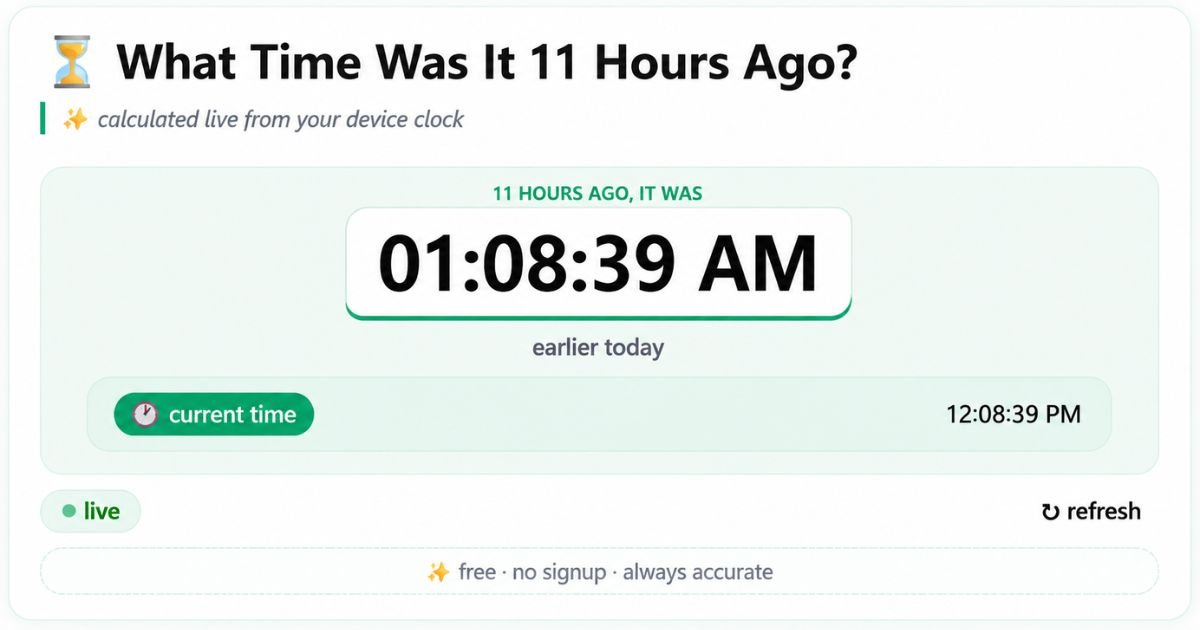
This is the most common version of the search, and it’s exactly what the live countdown at the top of this page answers automatically.
What Was 11 Hours From Now
Flip the direction, and you’re doing addition instead of subtraction — this is the hours from now calculation. Instead of looking at elapsed time in the past, you’re projecting forward.
Example: if it’s currently 3:00 PM, then 11 hours from now is 2:00 AM the following day. Just like the “ago” version, crossing midnight changes the date — only this time it moves the date forward, not back.
What Time Was It 12 Hours Ago
A close cousin to our main question. Twelve hours is exactly half a day, which makes it the simplest possible time calculation: just flip AM to PM or PM to AM, and the clock number stays the same. If it’s 3:00 PM now, 12 hours ago was 3:00 AM — same number, opposite half of the day.
11 Hours Ago From 9 Am
Using a fixed starting point instead of “now” is common when you’re working backward from a known event. Starting at 9:00 AM and subtracting 11 hours lands on 10:00 PM the previous day.
What Time Was It 11 Hours Ago Est
For Eastern Time specifically — the most-searched U.S. zone — the same rule applies, just anchored to ET. If it’s currently 8:00 AM EST, 11 hours ago EST was 9:00 PM EST the previous day. Always specify the zone when sharing this kind of answer with someone outside your region.
What Time Was It 11 Hours Ago 2022
Searches like this usually involve checking a historical record — a log, a message, or an old timestamp — rather than the current moment. For this, you need the exact original date and time, then apply the same subtraction. A date calculator with a custom date field handles this cleanly, since you’re not working from “now” at all.
11 Hours Ago From 10 Am
Another fixed-anchor example: starting from 10:00 AM and subtracting 11 hours brings you to 11:00 PM the previous day.
What Time Was It 11 Hours Ago Versus Hours From Now
Looking Back
Looking back means subtraction. You’re moving from your current time into the past, and the date can only move backward (or stay the same) as a result.
Looking Forward
Looking forward means addition — the hours from now version. You’re projecting into the future, and the date can only move forward (or stay the same).
Keeping these two directions mentally separate prevents the single most common mistake people make with this kind of math.
Common Mistakes When Calculating Eleven Hours Ago
- Forgetting to flip AM/PM when the subtraction crosses noon or midnight
- Missing the date rollover — assuming it’s still “today” when it isn’t
- Confusing “ago” with “from now” — subtracting when you meant to add
- Ignoring time zones when the reference “now” belongs to someone else
- Overlooking Daylight Saving Time — during a DST changeover, an 11-hour window can actually be 10 or 12 clock-hours depending on the date, which throws off manual math if you’re not paying attention
Everyday Situations Where This Calculation Matters
- Scheduling calls or meetings across U.S. time zones
- Verifying an alibi or activity against a timestamp
- Reviewing security footage or server access logs
- Adjusting to jet lag after a long flight
- Confirming when a message, post, or notification actually arrived
Similar Time Calculators You Might Need
- 11 hours from now calculator
- 12 hours ago calculator
- 10 hours ago calculator
- 24 hours ago calculator
- Hours between two times calculator
- Custom date calculator for any past or future point
Time Calculation Tips for Better Accuracy
- Use 24-hour format when precision matters — it removes AM/PM guesswork entirely
- Always confirm which time zone “now” refers to before calculating
- Use a live time calculator instead of manual math for anything important
- Double-check date changes whenever your starting point is near midnight
Related Concepts Worth Knowing
- UTC vs. local time — the global reference point behind every time zone
- Military time format — the 24-hour system used in logistics, medicine, and the military
- Time zone converter — for translating a specific time across regions
- Elapsed time calculator — for measuring duration between two known points rather than a single offset
- Unix timestamp / epoch time — how computers track time internally
Latest Videos, Feedback, and Suggestions
Have a correction, a request for a different duration, or a specific U.S. time zone example you’d like added? Let us know in the comments below — this page is updated based on real reader questions.
Final Thoughts
Figuring out what time was it 11 hours ago comes down to one simple habit: subtract 11 from the current hour, and watch for the date rollover if your starting time is before 11:00 AM. Whether you work it out by hand or lean on a time calculator, the logic never changes — only the starting point does.
Frequently Asked Questions
11 hours ago
Subtract eleven hours from now; check if date changed.
what time was it 11 hours ago
Current time minus 11 hours, adjusting AM/PM accordingly.
11 hours ago from now
Same as above — subtraction from present moment now.
what was 11 hours ago from now
Eleven hours before this moment, possibly previous day.

Hi, I’m John Wick, the admin at Magazineaura.com. I make measurements simple and easy to understand, from bed sizes to everyday length conversions. Clear guides. Accurate dimensions. No confusion.