Width is one of the first measurement words we learn, yet it’s also one of the most misunderstood. From the moment a child compares two crayons to see which one is “wider,” they’re already using an early form of mathematical reasoning.
This guide breaks down what width really means, how it connects to length, height, and depth, and why understanding width matters far beyond the math classroom.
You’ll also find teaching strategies, common misconceptions, and quick answers to the questions people ask most about width.
What Is Width? (Definition & Meaning)
At its simplest, width is the measurement of an object from one side to the other, usually taken at a right angle to its length. If you’ve ever measured how wide a table is, you’ve already practiced this concept without needing a textbook.
The word “width” comes from the adjective “wide,” the same way “depth” comes from “deep” and “height” comes from “high.” Some older texts use “breadth” instead of width — the two terms mean the same thing.
Width definition, in plain terms: the side-to-side distance of an object, expressed in a unit of length like inches, feet, or centimeters.
Understanding Width In Mathematics
In geometry, width is treated as one of the basic dimensions used to describe both flat (2D) shapes and solid (3D) objects. For a rectangle, width is typically the shorter of the two sides, while length is the longer one. For a box or rectangular prism, width joins length and height to describe the object in three dimensions.
Width shows up constantly in formulas. The most familiar is:
Area = Length × Width
This single formula is the foundation of a huge amount of elementary and middle school geometry. Once students grasp it, they can also work backward — if they know the area and the length, they can solve for the missing width. That backward step is where understanding width as a flexible, calculable value, not just a fixed label, really clicks for most learners.
Width is a core mathematical concept because it gives shape to abstract space — it turns “this rectangle” into “this rectangle, 4 inches by 9 inches.”
Width vs. Length vs. Height vs. Depth (Key Differences)
These four words get mixed up because English doesn’t have one strict rule for using them. Context, and the orientation of the object, usually decides which term fits best.
Width vs. Length
Length is generally the longest side of an object. Width is the shorter side, measured at a right angle to length. Think of a hallway: its length runs the long way, its width the short way across.
Width vs. Height
Height always refers to the vertical measurement, from bottom to top, no matter how long or short it is compared to width. A bookshelf’s height can be greater or smaller than its width — orientation decides the label, not size.
Width vs. Depth (and Breadth)
Depth usually measures front-to-back distance, like how far a drawer extends into a cabinet. In many everyday contexts, depth and width are used almost interchangeably, and the “right” word simply depends on which direction feels more natural to describe.
Length, Width, Height & Depth
| Term | What It Measures | Typical Orientation |
|---|---|---|
| Length | The longest dimension | Horizontal |
| Width | Side-to-side distance | Horizontal, perpendicular to length |
| Height | Top-to-bottom distance | Vertical |
| Depth | Front-to-back distance | Horizontal, into the object |
Why Understanding Width Is Important
Width measurement isn’t just a math-class skill — it shapes how we plan spaces, build objects, and solve everyday problems.
Measurement And Comparison With Width
Every time you compare two objects — two picture frames, two rugs, two parking spaces — you’re relying on width measurement to make the comparison meaningful. Direct measurement, like laying a ruler across an object, gives an exact reading. This kind of hands-on comparison is often a student’s first real encounter with direct measurement as a formal skill, rather than just an eyeballed guess.
Width And Developing Spatial Awareness
Understanding how width relates to the space around it builds spatial reasoning skills that extend well past math class — packing a suitcase, arranging furniture, or parallel parking a car all depend on judging width accurately. Kids who practice comparing widths early tend to develop a stronger intuitive sense of how objects fit together in physical space.
Connecting Width To Area, Perimeter, And Volume
Width is one of the building blocks behind three major geometry formulas:
- Area = Length × Width
- Perimeter = 2 × (Length + Width)
- Volume = Length × Width × Height
Without a clear grasp of width, none of these formulas make sense as anything more than memorized steps. That’s why width deserves more classroom attention than it usually gets — it’s the quiet backbone behind area, perimeter, and volume alike.
How To Measure And Calculate Width
There are two main ways to find a width: measuring it directly, or calculating it using a formula.
Tools For Measuring Width
The simplest way to measure width is direct measurement using a ruler, tape measure, or yardstick. For larger spaces — a driveway or a room — a tape measure or laser distance tool works better than a standard 12-inch ruler. This kind of physical measurement builds confidence because the result is immediate and visible.
The Width Formula
When you can’t measure directly, say you only know a rectangle’s area and length, you can use indirect measurement to solve for width:
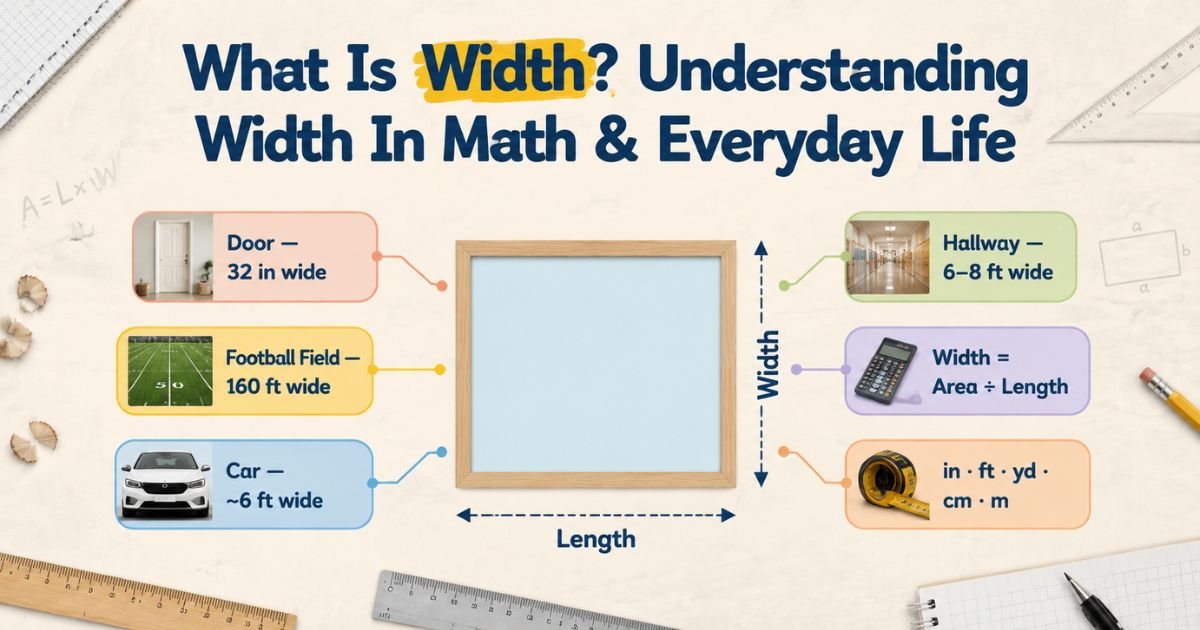
Width = Area ÷ Length
This kind of problem-solving, working backward from known values, is common in real-world problems like flooring, fabric, or construction estimates.
Standard Units Of Width
Width is expressed in standardized units — inches, feet, and yards in the customary system used across the U.S., or centimeters and meters in the metric system.
U.S. Customary vs. Metric Units
| System | Common Units |
|---|---|
| Customary (U.S.) | inch, foot, yard |
| Metric | millimeter, centimeter, meter |
Younger students often start with non-standard units like paperclips or cubes before moving to standardized units, an approach that makes measuring width concrete before it becomes numerical.
Teaching Strategies For Width
Width is easiest to teach when abstract ideas are grounded in something students can touch, see, or compare.
Hands-On Exploration of Width
Handing students non-standard units — blocks, paperclips, or classroom cubes — to measure the width of a desk or book turns an abstract idea into hands-on measurement they can repeat and check. This kind of physical measurement activity is especially effective in early grades, where concrete experience builds the foundation for later formula-based work.
Classroom snapshot: In one elementary classroom, students who measured their desks with paperclips before switching to a ruler consistently linked their non-standard results to the correct inch value with far fewer errors than students who started with a ruler alone.
Visual Models for Understanding Width
Grid paper, labeled diagrams, and simple drawings are some of the most effective visual models for teaching width, because they let students see the side-to-side distance instead of just calculating it. Shading a grid to represent a rectangle’s width and length, side by side, helps students connect the visual and the numerical before jumping into formulas.
Abstract Reasoning With Width
Once students are comfortable measuring width directly, they’re ready to reason about it abstractly — solving for missing width using the area formula, or comparing widths without physically measuring them. Moving from visual models to symbolic formulas supports mathematical understanding that goes beyond memorization, preparing students for algebra problems that use width as a variable rather than a fixed number.
Real-Life Examples Of Width
Width isn’t confined to worksheets. It shows up constantly in daily American life:
- A standard interior door is about 32 inches wide
- A U.S. football field is 160 feet wide
- A typical car is roughly 6 feet wide, a detail every driver judges when parking
- A school hallway is often built 6 to 8 feet wide to meet building codes
- A swimming pool’s “width” is the distance swum in a single lap, not its length
“When students measure the width of their own desk instead of a textbook diagram, the concept stops being abstract and starts being real” — a common observation among elementary math educators.
These everyday examples turn width into something students can verify for themselves, rather than take on faith.
Common Misconceptions About Width
Even capable students pick up a few incorrect “rules” about width along the way. Here’s the one that shows up most often.
Misconception: Width Is Always The Shorter Side
This is the most common myth about width, and it’s only true by convention, not by mathematical law. In many textbooks, width is presented as the shorter side of a rectangle purely for consistency, not because there’s a rule requiring it. A shipping box, for example, can easily have a width greater than its height. The safest approach, and the one math specialists consistently recommend, is to label dimensions clearly rather than assume width must always be the smaller number.
Frequently Asked Questions About Width
What is width and example? Width is the side-to-side measurement; example: a door’s width.
What is the size L x W x H? It’s how boxes list length, width, and height dimensions.
Which is the width and length? Length is the longer side; width is the shorter.
What is width in size? Width is the side-to-side size measurement in dimensions.
How do you find width from area and length? Divide the area by the length: Width = Area ÷ Length.
Conclusion
Width might seem like a simple word, but it’s a foundational mathematical concept that connects measurement, geometry, and everyday spatial reasoning. Whether you’re teaching a child to compare two toy cars or calculating flooring for a renovation, a solid grip on width supports far more than a single lesson — it supports mathematical understanding that carries into area, volume, and beyond. The next time you ask “how wide is this?”, you’re tapping into one of math’s most practical, most used ideas.
Arizona Tea Can Dimensions And Gatorade Bottle Dimensions And Soda Can Dimensions And Red Bull Can Dimensions And Dimensions of Monster Can And Coke Can Dimensions And Pokémon Card Dimensions Gatorade Bottle Dimensions And Arizona Tea Can Dimensions

Hi, I’m John Wick, the admin at Magazineaura.com. I make measurements simple and easy to understand, from bed sizes to everyday length conversions. Clear guides. Accurate dimensions. No confusion.