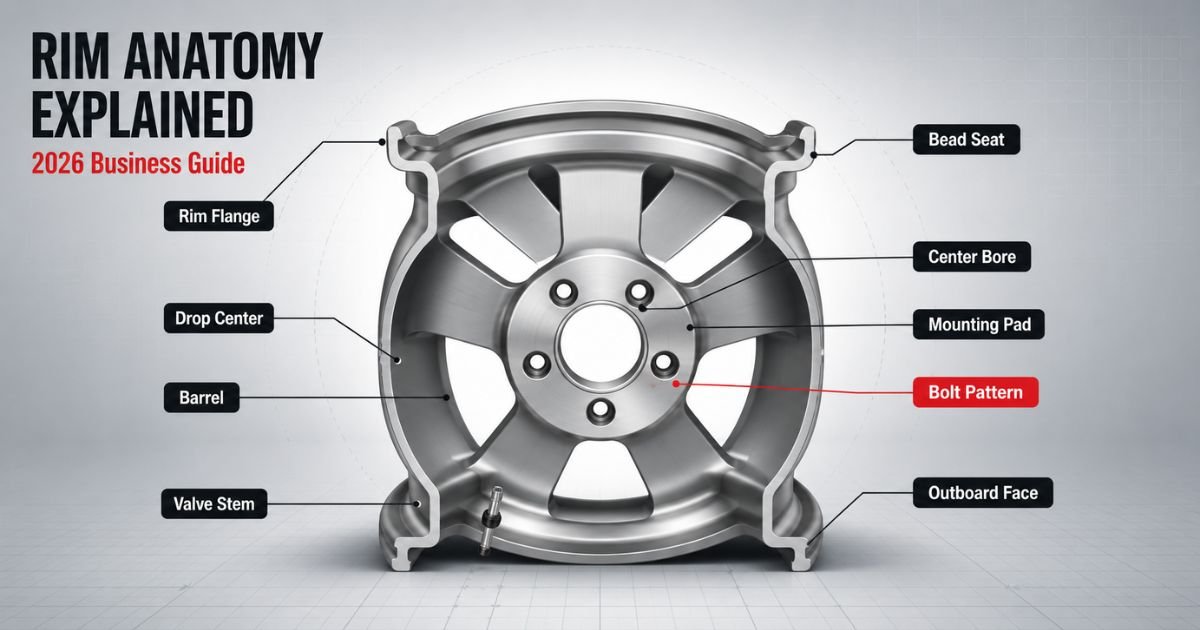
Most wheel fitment complaints don’t come from bad luck. They come from someone skipping the basics of rim anatomy. If you sell, install, or spec wheels in 2026, knowing every part of the rim parts puzzle is what separates a smooth sale from a costly return.
What Does Rim Mean?
The rim is the outer edge of the wheel — the section that grips and seats the tire. It’s not the whole wheel. It’s one piece of a bigger assembly, and mixing up the two terms is where a lot of confusion starts for buyers and sellers alike.
Technically, the rim includes the outer flange, the bead-sealing surface, and the recessed well used for mounting. Everything else — the center hole, the spokes, the mounting surface — belongs to the wheel as a whole. Small distinction, big impact when you’re troubleshooting a wheel fitment issue or writing a spec sheet.
Wheel vs Rim: What’s the Difference?
A wheel is the complete metal assembly that bolts to your vehicle’s hub and carries the tire. A rim is just the outer ring of that wheel — the part that touches the tire directly.
In casual conversation, people say “rim” when they mean the whole wheel. You’ll hear it at the shop counter, on marketplace listings, and in customer emails every day. That’s fine for small talk. It’s not fine when you’re placing an order, because a mismatch between what a customer means and what your paperwork says is exactly how the wrong bolt pattern or center bore ends up in a box.
Here’s the simple way to remember it: every rim is part of a wheel, but not every part of a wheel is the rim. Keep that line in your back pocket — it settles more disputes than you’d think.
Parts of a Wheel Table: Quick Overview
Before we go part by part, here’s the full picture in one table. Each row affects tire seating, safety, or fitment in its own way, and knowing which part causes which problem saves you diagnostic time on the shop floor.
Parts of a Wheel — Quick Overview
| Part | What It Is | Why It Matters | Common Problem |
|---|---|---|---|
| Rim Flange | Outer edge that holds the tire bead | Bead retention and secure seating | Bent flange causes air leaks |
| Bead Seat | Surface where the tire bead rests | Airtight seal, safe mounting | Corrosion causes slow air leaks |
| Drop Center | Recessed area in the barrel | Makes tire mounting possible | Wrong shape complicates fitting |
| Barrel | Cylindrical body of the wheel | Strength, width, brake clearance | Barrel damage causes vibration |
| Spoke Face | Visible section connecting hub to rim | Styling, load distribution, brake clearance | Poor design limits brake fitment |
| Center Bore | Hole that fits over the vehicle hub | Centering and smooth rotation | Wrong size causes vibration |
| Mounting Pad | Contact surface at the hub | Offset reference, load transfer | Bad machining causes fitment issues |
| Bolt Pattern Area | Holes for lug nuts or bolts | Must match vehicle exactly | Wrong PCD is unsafe |
| Valve Stem | Opening for the valve | Inflation and pressure retention | Poor seal causes air loss |
Main Parts of a Rim (And Why They Matter)
Now let’s slow down and unpack each of these components one at a time. These are the nine pieces that decide whether a wheel seats cleanly, holds air, and survives daily driving without a comeback.
1. Rim Flange
The rim flange is the outermost lip of the rim, and it’s usually the first thing that touches the tire bead. Its job is simple but critical: keep the bead locked in place so the tire doesn’t slip during hard cornering or sudden impacts.
Curb damage is this lip’s biggest enemy. Even a small dent can create a gap that leads to air leaks, and a badly bent edge can make mounting a new tire nearly impossible without machining or replacement. If you run an installation bay, a quick check before and after every job catches problems before a customer drives off with a slow leak.
2. Bead Seat
The bead seat is where the tire bead actually rests and seals once the tire is inflated. Think of it as the handshake between rubber and metal — if that handshake isn’t clean, air finds a way out.
Pitting, rust, or old sealant residue on this surface are common culprits behind mystery air leaks that keep sending customers back for “just one more top-off.” A clean sealing surface isn’t optional — it’s the difference between a tire that holds 32 PSI for months and one that needs attention every other week.
3. Drop Center (Well)
The drop center — also called the wheel well — is the deepest point of the barrel, usually sitting in the middle or offset slightly to one side. Without it, mounting a tire would be close to impossible, since the tire’s inner diameter and the wheel’s outer diameter are nearly identical.
During installation, a tire technician pushes one side of the tire down into this recess so the rest of the tire can slip over the flange. It’s a small design detail with an outsized job: no drop-center well, no tire mounting, period. This spot is also where cracks tend to show up first after a hard pothole hit, especially on low-profile setups.
4. Barrel
The barrel is the full cylindrical body of the wheel — the section that houses the drop center and gives the tire something to sit inside of. Barrel width and depth directly shape tire fitment, air volume, and how much clearance you have around the brakes.
Wider barrels generally mean wider tires, which usually means more grip and more performance demand on the wheel itself. If you’re speccing wheels for a customer doing a staggered setup, the barrel is where that conversation should start.
5. Outboard Face (Spoke Face)
This is the visible side of the wheel — where the spokes live and where most of the design personality shows up. It’s easy to think of this as purely cosmetic, but it carries real structural weight too.
Spoke design affects load capacity, weight distribution, and — this one catches people off guard — brake clearance. Aggressive concave designs look sharp on a build sheet but can physically collide with big brake kits. Always check clearance specs before recommending a deep-dish style to a customer running upgraded brakes.
6. Hub Core (Center Bore)
The center bore is the hole on the back of the wheel that fits directly over the vehicle’s hub. Get this measurement wrong and you’re not just dealing with a minor inconvenience — you’re looking at vibration, uneven handling, and a customer who no longer trusts your recommendations.
Precision matters here more than almost anywhere else on the wheel. Manufacturers rely on tight-tolerance machining to hit the correct bore size consistently, and any aftermarket wheel with a larger bore than OEM needs a hub-centric ring to stay properly centered. Skip that step, and you’re inviting a warranty claim.
7. Mounting Pad
The mounting pad is the flat surface on the back of the wheel that makes direct contact with the vehicle’s hub. It’s also the reference point offset gets measured from, which makes it more important than its small size suggests.
A pad that’s machined too thick or too thin throws off the entire offset calculation, and that ripple effect hits suspension geometry, tire clearance, and overall wheel fitment. This is one of those parts nobody notices until it’s wrong — and then everyone notices.
8. Bolt Pattern Area (Lug Holes)
This is where the lug nuts or bolts pass through to fasten the wheel to the hub, and it changes depending on the vehicle. A common bolt pattern might read 5×120 or 5×114.3 — numbers that describe the pitch circle diameter, or PCD.
In plain terms, 5×120 means five lug holes arranged on a 120mm diameter circle. Getting this number right the first time isn’t just good service — it’s the difference between a happy customer and an unsafe installation. There’s no gray area with bolt pattern accuracy; it either matches or it doesn’t.
9. Valve Stem
The valve stem is a small part with a big job. Found on the barrel, it’s what lets you add or release air and keep pressure steady over time. It handles the same role whether you’re checking a daily driver or servicing a fleet vehicle.
A cracked or poorly seated valve stem causes a steady, frustrating loss of air pressure that mimics a tire problem — which means misdiagnosed leaks and wasted shop time. Rubber stems wear out faster in extreme heat, while metal ones last longer but demand a tighter seal. Stocking quality valve stems is a small upsell that builds real customer confidence.
Bonus: Multi-Piece Rim Parts
Two-piece and three-piece rims bring a few extra components into the mix, and it’s worth knowing them if you deal in custom or performance builds:
- Outer lip – the outermost section of the rim, often polished or chrome-finished, sitting beyond the standard rim flange.
- Inner barrel – common on three-piece rims, this is the structural inner half that carries much of the load.
- Center disc – the spoke section that bolts between the inner and outer halves, letting builders customize offset and style.
Modular wheels open up serious flexibility for custom stances, but they demand precise torque specs and careful sealing to stay airtight. Skip either step and you’re looking at slow air leaks or, worse, a wheel that comes apart under load.
Rim Diameter, Width, and Offset Explained
Rim anatomy isn’t just about naming parts — it’s also about how those parts get measured. A typical size reads something like 17×8.5 +35: diameter first, width second, offset last.
Diameter is the measurement across the bead seats, and it dictates which tire sizes will physically fit. Width is the distance between the inner and outer bead seat faces, and it plays a direct role in how much tire sidewall support you get. Offset is the distance, in millimeters, from the wheel’s true centerline to the mounting pad — positive offset tucks the wheel in toward the suspension, negative offset pushes it outward for a wider stance.
Here’s why this matters for tire fitment: a tire that clears comfortably at +35mm offset can rub the fender at -12mm on the exact same wheel diameter. Offset isn’t a cosmetic detail — it’s a clearance calculation, and getting it wrong is one of the fastest ways to turn a simple wheel order into a comeback.
Rim Materials: Cast vs. Forged vs. Flow-Formed
The way a rim is built changes how its parts perform under stress, and this is where manufacturing method meets anatomy.
Rim Materials: Cast vs. Forged vs. Flow-Formed
| Material | Strength-to-Weight | Typical Barrel | Best For |
|---|---|---|---|
| Cast | Lower | Heavier, more material | Budget builds, daily driving |
| Flow-Formed | Balanced | Thinner, reinforced barrel | Daily driving with performance upside |
| Forged | Highest | Thin, dense, precise | High-performance, heavy-duty, commercial |
Cast wheels are molded in one piece and tend to carry more material in the barrel, which keeps costs down but adds weight. Flow-formed wheels start as a cast blank and get spun under heat and pressure, tightening the barrel’s grain structure for a stronger, lighter result without a forged price tag. Forged wheels are pressed from a solid billet, giving them the cleanest rim flange machining and the highest strength-to-weight ratio on the market — which is exactly why they dominate high-performance and commercial applications where failure isn’t an option.
Final Thoughts – Know the Parts, Boost the Profits
Whether you’re moving forged performance wheels or basic alloy rims, understanding rim parts puts your business in the driver’s seat. It’s not just trivia for a spec sheet — it’s the foundation of fitment confidence, customer safety, and repeat business.
In a crowded market, the sellers who actually understand rim anatomy are the ones customers come back to. Everyone else is just guessing and hoping the return rate stays low.
Ready to Turn Your Rim Parts Knowledge Into Revenue?
Start with your team. If your staff can explain a bead seat from a drop center without blinking, your fitment errors drop and your customer trust climbs.
From there, refine your ordering process, tighten your wheel fitment checks before shipping, and stock the parts that back up good service — quality valve stem kits, hub-centric rings, and lug hardware that matches every bolt pattern you sell. Small operational fixes like these compound fast, and they cost far less than a warranty claim.
Related Products
Explore off-road wheels built for tougher terrain, aftermarket options for daily drivers, and OE-style replicas for customers who want a factory look with aftermarket value. Each product line ties directly back to the components covered above — diameter, offset, and bolt pattern all factor into which style fits which build.
2026 E-Catalog
Download the current wheel catalog for full specs, sizing charts, and finish options across every category mentioned in this guide.
Parts of a Car Wheel and Axle
The axle isn’t technically a rim part — it’s what the wheel bolts onto. The center bore is where these two systems meet: the bore fits over the axle’s hub, and the lug holes secure it in place. Confusing the two is common in casual searches, but the distinction matters for anyone doing actual fitment work.
Anatomy of a Tire Wheel
Zoom out and the tire-and-wheel combo works as one sealed system. The tire’s bead locks into the bead seat, the rim flange holds that bead in place under load, and the drop center is what made mounting that tire possible in the first place. Every part covered above still applies — this is just the same anatomy viewed through the tire’s side of the relationship.
Car Wheel Parts Names With Pictures
A labeled diagram makes this entire guide easier to apply on the shop floor. If you’re building this out visually, map each rim parts term above — flange, bead seat, drop center, barrel, spoke face, center bore, mounting pad, bolt pattern, valve stem — directly onto a cutaway image so staff can match the word to the physical spot in seconds.
Car Wheel Anatomy
This is the umbrella term for everything we’ve covered: the rim, the hub, the spokes, and the fasteners working together as one system. If you only remember one thing from this section, remember this — wheel anatomy is bigger than rim anatomy, and the rim is just the outer layer of a much bigger picture.
Parts of a Car Wheel Suspension
Wheel anatomy touches suspension geometry at exactly one point: the mounting pad and center bore, where the wheel meets the hub assembly. Offset, bearing preload, and hub-centric fit all ripple into how the suspension behaves — which is why a wrong center bore doesn’t just cause vibration, it can accelerate bearing wear too.
Rim Flange
Worth repeating on its own: the rim flange is the raised outer edge that keeps the tire bead seated and sealed. Curb rash, potholes, and aggressive cornering are its biggest threats. A damaged flange is one of the fastest routes to persistent air leaks, so it deserves its own line item on any pre-sale inspection checklist.
What Is Done With The Wheel Of A Car Crossword Clue
If you landed here from a crossword puzzle, the answer is usually a short word like “rim” or “tread,” depending on the clue’s phrasing. If you’re here for the real automotive answer instead, scroll back up — that’s exactly what the rest of this guide covers in detail.
Parts of a Wheel Assembly
The full assembly goes beyond the rim itself. It includes the hub, the bearing, the fasteners, and every rim parts component discussed above, all working as one unit. Where “rim parts” refers to the outer ring specifically, “wheel assembly” covers everything that bolts together to make the wheel function as a whole.
Why Should Businesses Pay Attention to Bead Seats and Flanges?
They control air sealing, tire retention, and safety.
Are All Rim Components Standardized Across Brands?
No, dimensions and tolerances vary by manufacturer and type.
How Do Structural Rim Parts Differ Between Cast and Forged Wheels?
Forged wheels are thinner, denser, and stronger overall.
Is a Rim the Same as a Wheel?
No, the rim is just one wheel component.
What Part of the Wheel Holds the Tire?
The rim’s flange and bead seat hold it.
Why Do Lug Holes Matter in Wheel Fitment?
They must match the vehicle’s exact bolt pattern.
Conclusion
Rim anatomy isn’t trivia — it’s the difference between confident fitment and expensive guesswork. Know these parts, and every wheel decision gets easier from here.
15 common things that weigh 300 grams
16 common things that weigh 500 grams
22 common things that weigh 20 grams
15 common things that weigh 10 grams
20 common things that weigh 1 gram
18 common things that weigh 100 grams
20 common things that are 10 inches long
18 common things that are 16 inches long
14 common things that are 40 inches long
things that are 40 inches long
20 common things that are 15 inches long
18 common things that are 12 inches long
things that are 40 inches long
18 common things that are 7 inches long
18 common things that are 18 inches long
16 common things that are 4 inches long
20 common things that are 8 inches long
19 common things that are 3 inches long
15 common things that are 20 feet long
18 common things that are 13 inches long
17 common things that are 20 inches long
17 common things that are 6 inches long
17 common things that are 5 inches long
13 common things that are 2 inches long
20 common things that are 24 inches long
20 common things that are 30 inches long
20 common things that are 36 inches long
15 common things that are 59 inches long
20 common things that are 19 inches long
20 common things that are 26 inches long
20 common things that are 100 inches long
20 common things that are 9 inches long
20 common things that are 57 inches long
20 common things that are 34 inches long
20 common things that are 96 inches long
20 common things that are 5.7 inches long
20 common things that are 1.375 inches long
20 common things that are 1.25 inches long
25 common things that are 11 inches long
20 common things that are 1 inch long
20 common things that are 2.4 inches long
20 common things that are 2.75 inches long
20 things that are 102 inches long
20 common things that are 42 inches long
20 common things that are 55 inches long
15 Common Things That Weigh 12 Kg (2026 Real-World Comparisons)
20 Common Things That Weigh 15 kg — 2026 (Real-World Comparisons)
15 Common Things That Weigh 100 Kg (2026 Plus Exact Conversions)
20 Common Things That Weigh 30 kg — (2026 Real-World Comparisons)
15 Things That Weigh 70 Kg (2026 Real-World Comparisons)
15 Common Things That Weigh 25 kg – 2026 (Real-World Comparisons)
How Heavy Is 50kg? 10 Things That Match It Perfectly in 2026
How Heavy Is 40kg? 10 Things That Match It Perfectly in 2026
How Much Is 10kg? 15 Common Things That Weigh 10 Kilograms (2026)
How Heavy Is 20kg? 10 Things That Match It Perfectly in 2026
15 Things That Weigh 50 Ounces (Everyday Examples, 2026)
How Much Is 7 Ounces? 20 Most Common Things That Weigh About 7 Ounces
15 Common Things That Weigh 15 Ounces (With Real Life Examples)
20 Common Things That Weigh 10 Ounces (With Real Life Examples)
10 Common Things That Weigh 2 Ounces (With Pictures & Comparisons)
8 Common Things That Weigh 3 Ounces (With Real Life Examples)
15 Common Things That Are 30 Feet Long – 2026 (With Real-Life Comparisons)
15 Common Things That Are 300 Feet Long – 2026 (Real-Life Examples)
15 Common Things That Weigh 50 Lbs (50 Pounds) 2026 Everyday Objects
15 Common Things That Weigh 20 Lbs (With Everyday Comparisons)
15 Common Things That Weigh 10 Lbs (With Everyday Examples)
15 Common Things That Weigh 10 Pounds (2026)
15 Common Things That Are 50 Feet Long – 2026 (With Real-Life Comparisons)
How Far Is 500 Feet? 15 Most Common Things That Are 500 Feet Long
How Long Is 25 Feet? 20 Most Common Things That Are Exactly (or Super Close to) 25 Feet Long
20 Common Things That Are 44 cm Big (With Real-Life Examples)
20 Common Things That Are 2 cm Big (With Real-Life Examples)
20 Common Things That Are 5 cm Big: A Complete Size Guide
20 Common Things That Are 20 CM Big (With Inch Conversions)
20 Common Things That Are 30 cm Big (With Inch Conversions)
How Big Is A Centimeter? 18 Everyday Objects That Show You Exactly
Sig Fig Calculator: The Fast, Accurate Way to Count and Round Significant Figures
What Is Width? A Complete Guide to Understanding Width in Math and Everyday Life
How Long Until 3:15 PM? Live Timer Check the Exact Time Left Instantly
20 Common Things That Are 10 Meters Long (With Visual Comparisons)
20 Common Things That Are 3 Meters Long (With Easy Comparisons)
How Far Is 500 m Really? 20 Famous Things & Everyday Distances That Equal About 500 Meters Long
How Long Is 20 Meters In Comparison To 20 Everyday Objects
How Long is 30 Meters? 25 Most Common Distances And Things That Are 30 Meters Long -2026
20 Common Things That Are 2 Meters Long/Tall (2026)
How Long Is 100 Meters? 15 Common Things That Are 100 Meters Long
How Long Is 5 Meters? 15 Common Things That Are 5 Meters Long
How Long Is 50 Meters? 15 Common Things That Are 50 Meters Long
How Long Is 4 Meters? 15 Common Things That Are 4 Meters Long
How Long Is 300 Meters? 15 Common Things That Are 300 Meters Long
Karen Backfisch-Olufsen: The Story of Jim Cramer’s Ex-Wife
Amy Sherrill: The Real Story Behind Tim Duncan’s Ex-Wife
Mary Carey Van Dyke: The Story Behind Barry Van Dyke’s Wife
Matthew Mario Rivera: The Story Behind Kasie Hunt’s Husband
Constantine Yankoglu: The Story of Patricia Heaton’s First Marriage
Gatorade Bottle Dimensions: A Complete Guide With Facts
Arizona Tea Can Dimensions: Size, Height & Width Guide With Facts
How Long Is 5 Inches? 20 Everyday Objects That Are 5 Inches Long With Pictures
How Long Is 7 Inches? 20 Common Things That Are 7 Inches Long
20 Common Things That Measure 50 Feet Long or Big With Pics
How Long Is 2 Feet? 12 Common Things That Are 2 Feet Long With Pics
How Long Until 3 PM? The Ultimate Live Countdown Guide
Paula Ebben Age 2026: Husband, Family, Networth Bio and Secrets
Lolo Wood Net Worth: Age, Height, Career, Ridiculousness, Wild N Out & Motherhood (2026)
Dino Guilmette: A Deep Dive Into His Life, Career, and Personal Story
BigXthaPlug Age: His Net Worth, Height, Weight, and Life Story
Who Is Jeremy Yaffe? The Quiet Life Behind Alan Arkin’s Early Years
Pringles Can Dimensions: Size, Height & Diameter In Detailed 2026
Metric Socket Sizes Chart & Conversion Guide 2026
Metric Socket Sizes Chart & Conversion Guide In Detailed 2026
Per Stay Vs Per Night: Which Accommodation Pricing Option Is Cost-Effective?
How Tall Is the iPhone 16 in cm? (Official Size Guide) In Detailed
2×8 Actual Size: 1.5 in × 7.25 in (38 mm × 184 mm) — The Complete Guide
Lauren Compton: Early Life, Background, Wikipedia, Grokipedia, and Career (2026)
Brandi Belle: IMDb Profile, Early Life, Career, Personal Life and Grokipedia Guide
Matte Babel Wikipedia: Net Worth, Kids, Early Life, and Grokipedia Facts
Velicity Von: Early Life, Net Worth, Career, and Her Grokipedia Profile
What Is Erikkapost Com? The Honest Guide to Features, Pros and How It Works in 2026 Magazine Aura
SFM Compile: A Comprehensive Overview of Source Filmmaker Model Compilation (2026) Magazine Aura
How Long Until 2 PM? Live Countdown, Time Zones, and Manual Calculation Explained
How Long Until 3:30 PM? Live Countdown Timer, Calculator & Complete Guide
How Long Until 2:30 PM? Live Countdown Timer
How Long Until 2:30 PM? See Live Now
What Time Was It 15 Hours Ago? Live Countdown
What Time Was It 11 Hours Ago? Live Countdown & Instant Time Calculator
King Size Bed Dimensions: The Complete Size Guide
Everything You Need to Know About Crayola Air Dry Clay: A Complete Guide
Joylette Goble: The Untold Story of Katherine Johnson’s Daughter
Sharon Mobley Stow: The Untold Story of Jim Acosta’s Ex-Wife

Hi, I’m John Wick, the admin at Magazineaura.com. I make measurements simple and easy to understand, from bed sizes to everyday length conversions. Clear guides. Accurate dimensions. No confusion.