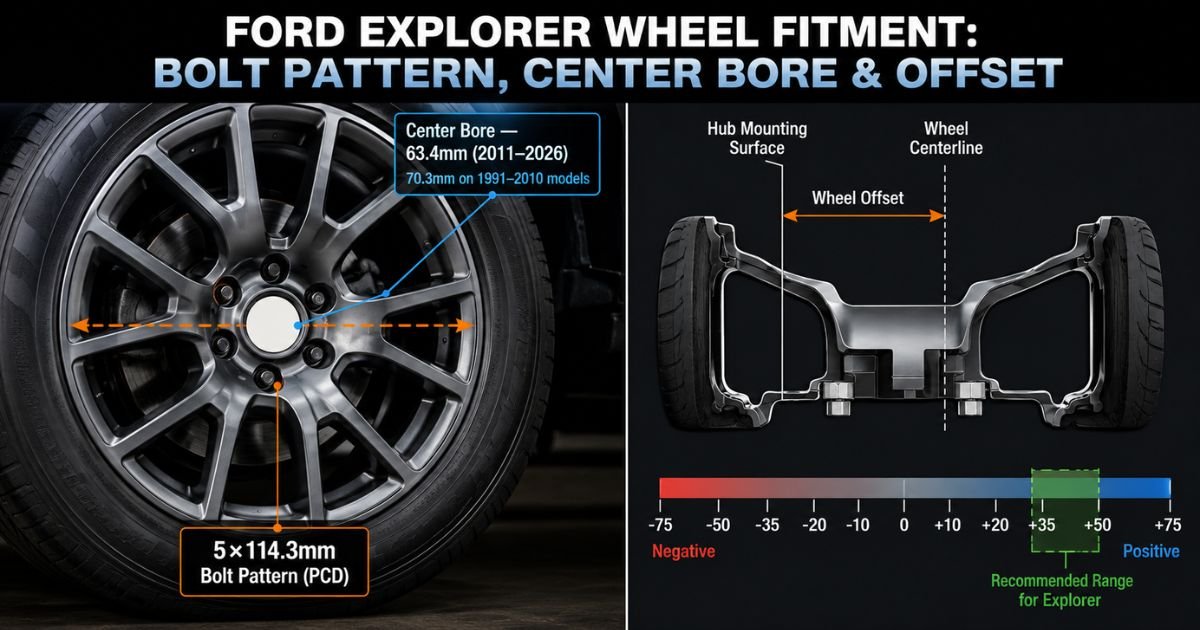
Buying the wrong wheels for a Ford Explorer is one of the most common and most expensive mistakes an owner or a wheel retailer can make. A mismatched Ford Explorer bolt pattern, an unchecked center bore, or the wrong wheel offset can turn a simple upgrade into a return, a refund, or worse, a safety hazard at highway speed. This guide breaks down everything you need to know about Ford Explorer fitment, from the bolt pattern itself to hub bore changes, brake clearance on performance trims, and the best wheel sizes for daily driving, towing, and off-road use.
Every Ford Explorer built since 1991 shares the same 5×114.3mm (5×4.5 inch) bolt pattern, also called the PCD or lug pattern. That fact makes the Explorer one of the easier SUVs to shop for but it hides real fitment traps. The hub bore changed significantly in 2011. Offset ranges shifted as the SUV moved from a truck-based frame to a unibody platform. Performance trims like the ST introduced brake calipers large enough to make otherwise-compatible wheels physically impossible to install.
This guide walks through every specification that matters and gives you a clear framework for choosing wheels that fit correctly the first time.
Key Takeaways
- The Ford Explorer bolt pattern has remained 5×114.3mm (5×4.5 inch) across every generation since 1991, making PCD the easiest spec to get right.
- The center bore is where most fitment problems happen. Pre-2011 Explorers use a larger hub bore than 2011-and-newer models, and mixing them up causes vibration or a wheel that simply won’t seat.
- Wheel offset on modern Explorers typically falls between +35mm and +50mm; straying outside this range risks fender rubbing or suspension contact.
- The Explorer ST and Police Interceptor trims use oversized brake calipers, which means brake clearance must be checked before ordering smaller-diameter alloy wheels.
- Because the Explorer is a heavy SUV with real towing capacity, load rating matters as much as bolt pattern wheels rated for sedans are not appropriate substitutes.
- The Explorer is a hub-centric vehicle, so hub-centric wheels (or hub-centric rings on aftermarket wheels) are required to prevent long-term vibration and stud fatigue.
Key Checks Before Buying Wheels for the Ford Explorer
Shopping for wheels by lug count alone is how most fitment mistakes happen. A Ford Explorer is a heavy vehicle with generation-specific hardware, and each trim level carries its own clearance requirements. Before you buy or before you list inventory for sale run through these checks.
Bolt Pattern (PCD)
The Ford Explorer uses a 5×114.3mm bolt pattern, meaning five lug positions arranged on a circle measuring 114.3mm in diameter. This is one of the most widely used PCDs in the automotive industry, shared with everything from the Mustang to a long list of Japanese and Korean sedans. That popularity is good news for stock availability, but buyers sometimes assume “5-lug” is close enough. It isn’t. A wheel drilled for 5×112mm or 5×115mm will look correct on the shelf but will not seat properly on an Explorer hub, and forcing it on risks stud damage. Always confirm the exact wheel bolt pattern reads 114.3mm, not a close metric neighbor.
Wheel Offset
Offset describes how far the wheel’s mounting surface sits from its centerline, and it determines whether the wheel tucks toward the chassis or pushes out toward the fender. Most modern Explorers run a positive offset in the range of +35mm to +50mm. Go too low and the tire can rub the fender liner during hard turns. Go too high and the inner wheel barrel can contact the strut, control arm, or brake hardware. Getting wheel offset right is just as important as matching the bolt pattern a wheel with the correct PCD can still be unusable if the offset is wrong for the trim.
Center Bore
The center bore, sometimes called the hub bore, is the round opening at the back of the wheel that slides over the vehicle’s hub. This is where most real-world Explorer fitment complaints originate. Earlier Explorers used a 70.3mm center bore, while the 2011-and-newer unibody generation moved to a smaller 63.4mm bore. A wheel with a bore smaller than the hub simply will not fit. A wheel with a bore larger than the hub will fit, but it needs hub-centric rings to prevent the wheel from riding on the lug nuts alone a setup that causes vibration and accelerated wear.
Brake Clearance
Newer Explorer trims, particularly the ST and the Police Interceptor Utility, are equipped with substantially larger brake calipers than the Base or XLT models. This changes the clearance math for wheels. The spoke design and barrel depth of a wheel need enough internal room sometimes called “X-factor” clearance to clear the caliper body without contact. This becomes especially important with smaller-diameter wheels, such as a 17-inch alloy wheel chosen for winter tires, where there’s simply less room inside the wheel to work with.
Load Rating for SUVs
An Explorer is not a lightweight sedan. Between curb weight, passengers, cargo, and towing capacity, the wheels need to be rated to handle real load. Most Explorer applications call for wheels rated between 1,600 lbs and 2,100 lbs per wheel. Installing wheels designed for smaller passenger cars even if the bolt pattern matches perfectly invites cracking, bending, or structural failure under sustained load. Always check the load rating stamped on the back of the wheel before finalizing a purchase.
Hub-Centric vs Lug-Centric
The Ford Explorer is engineered as a hub-centric vehicle. That means the vehicle’s hub, not the lug nuts, is designed to bear the weight of the SUV and keep the wheel centered. The lugs exist primarily to clamp the wheel in place, not to center it. Using hub-centric wheels, or adding quality centering rings to an aftermarket wheel with a larger bore, keeps the load path correct and prevents the shimmy that shows up at highway speed when a wheel is left to center on the lugs alone.
Ford Explorer Bolt Pattern by Generation
While the Ford Explorer bolt pattern has stayed fixed at 5×114.3mm since the model’s introduction, the supporting hardware around that bolt pattern has changed more than most buyers realize. The consistency of the PCD is genuinely useful, but it can create a false sense of security assuming “same bolt pattern” means “same wheel” is exactly how fitment mistakes happen.
Generative Evolution
The Explorer’s platform has evolved since 1991, and its wheel hardware evolved with it. First- and second-generation Explorers, built roughly from 1991 through 2010, sat on a truck-based frame and used a larger hub bore suited to that heavier, body-on-frame architecture. Starting with the 2011 model year, Ford transitioned the Explorer to a unibody crossover platform, and the hub bore shrank to accommodate the new suspension geometry. The design shifted again around the 2020 redesign, which kept the smaller hub bore but opened up wheel clearance requirements to fit larger brake packages across more trims.
Crucial Note for Retailers
The single most important cutoff to remember is the 2011 model year. Explorers built before 2011 use the larger hub bore, and Explorers from 2011 onward use the smaller one. Selling a 2011-or-newer wheel to an owner of an older Explorer means the wheel won’t fit at all. Selling an older wheel to a newer Explorer owner means the wheel will technically bolt on but leave a dangerous gap around the hub, inviting vibration that gets worse with mileage. Verifying center bore before shipping is the single easiest way to cut return rates on Explorer inventory.
Ford Explorer Bolt Pattern by Year Quick Reference
Ford Explorer Bolt Pattern by Year
| Generation | Model Years | Bolt Pattern (PCD) | Center Bore | Typical Offset | Lug Torque |
|---|---|---|---|---|---|
| 1st–2nd Gen (Truck-Based) | 1991–2010 | 5×114.3mm | ~70.3mm | +18mm to +35mm | 100–110 lb-ft |
| 3rd–4th Gen (Early Unibody) | 2011–2019 | 5×114.3mm | 63.4mm | +35mm to +44mm | 100–110 lb-ft |
| 5th–6th Gen (Current) | 2020–2026 | 5×114.3mm | 63.4mm | +35mm to +50mm | 150 lb-ft |
Always confirm exact torque specifications against the owner’s manual for the specific model year and trim, as figures can vary slightly by configuration.
Common Fitment Mistakes and Return Causes
High return rates quietly eat into margins for wheel retailers, and they’re frustrating for individual owners who just want their new wheels to fit. The good news is that nearly every Ford Explorer return is preventable with a few checks made before the order ships.
Ignoring Hub Bore Differences
The shift from roughly 70.3mm down to 63.4mm is the single biggest source of Explorer wheel complaints. Trying to mount a wheel built for a 2022 Explorer onto a 2005 model simply won’t work the bore is too small to clear the older hub. Going the other direction, fitting an older wheel’s larger bore onto a newer Explorer, leaves a gap that hub-centric rings are required to close. Skip that step and the driver will notice a vibration that worsens as speed increases.
Inadequate Brake Clearance on ST Trims
The Explorer ST is genuinely quick for an SUV, and Ford paired that performance with oversized brakes to match. Many 18-inch and 19-inch alloy wheels that bolt on cleanly to a Base or XLT trim will physically collide with the ST’s larger calipers. Anyone shopping wheels for an ST or a retailer fulfilling an ST order needs to verify spoke profile and internal barrel depth before shipping, not after.
Improper Load Ratings
It’s common for generic 5×114.3 wheels built for lighter sedans to end up marketed toward SUV owners simply because the bolt pattern matches. These wheels can crack or deform when an Explorer is fully loaded with passengers and cargo, or when it’s used for towing. Checking the load rating stamped on the back of the wheel takes seconds and prevents a genuinely dangerous failure down the road.
Thread Pitch and Lug Seat Mismatches
Explorer wheels use M14 x 1.5 lug nuts with a conical seat design. Mixing lug nut styles using a ball-seat nut on a wheel designed for a conical seat, for example prevents the nut from torquing down evenly against the wheel face. This is a smaller mistake than a bolt pattern mismatch, but it still results in loose wheels and uneven clamping force if it’s overlooked.
Wheel Size Options for Ford Explorer
Choosing the right wheel size changes far more than the Explorer’s appearance. Diameter affects ride quality, tire cost, fuel economy, and how the SUV behaves both on pavement and off it. Bigger wheels look aggressive, but they also mean shorter tire sidewalls, which transmit more road imperfection into the cabin something that works against the smooth, quiet ride most Explorer owners actually want.
17 Inch Alloy Wheels
Seventeen-inch wheels are the practical choice for winter setups and rugged utility use. The taller tire sidewall that comes with a smaller wheel diameter absorbs impacts far better than a low-profile tire on a larger rim, and it’s noticeably more forgiving on rough pavement or light trails. For fleet buyers and budget-conscious owners, 17-inch alloy wheels also come with the added benefit of cheaper tire replacement costs over the life of the vehicle.
20 Inch Alloy Wheels
The 20-inch wheel is the most popular size fitted to modern Explorers, and for good reason it strikes the clearest balance between style and comfort. It’s large enough to fill out the wheel well and look proportional to the SUV’s body, while still leaving enough sidewall on the tire to keep the ride comfortable. From an inventory standpoint, 20-inch wheels also tend to fit the widest range of Explorer trims without running into clearance issues.
Off-Road Setups
Owners planning to take an Explorer off pavement need off-road wheels built for the job, typically paired with all-terrain tires. These setups usually run a slightly lower offset than the factory spec, which pushes the wheel outward for a wider, more stable stance. That wider footprint improves lateral stability on uneven terrain, though it does require double-checking fender clearance to avoid rubbing during suspension travel.
Best Wheel Types for Ford Explorer
Alloy Wheels
Standard cast alloy wheels remain the backbone of the aftermarket Explorer market. They’re lighter than the factory steel wheels found on base trims, they come in a huge range of finishes and spoke designs, and they offer real curb appeal at a reasonable price point. For most daily-driver Explorers, a quality cast alloy wheel is more than enough.
Forged Monoblock Wheels
For performance-oriented trims like the Explorer ST, forged monoblock wheels are the upgrade worth considering. Machined from a single piece of aerospace-grade aluminum, forged wheels are both stronger and significantly lighter than a cast wheel of the same size. That reduction in unsprung weight improves handling response and reduces stress on the suspension components a meaningful advantage on a heavier SUV being pushed to perform.
Off-Road Wheels
Explorer owners heading into rougher terrain need wheels built specifically to handle it. Dedicated off-road wheels are engineered to absorb lateral stress from uneven surfaces and often feature reinforced lips designed to resist curb rash and rock strikes protection a standard street wheel simply isn’t built to provide.
Popular Ford Explorer Wheel Configurations
Popular Ford Explorer Wheel Configurations
| Wheel Size | Best Use Case | Advantages | Potential Limitations |
|---|---|---|---|
| 17″–18″ | Off-road & winter driving | Better ride comfort, cheaper tire replacement | Less aggressive appearance |
| 20″ | Daily driving | Ideal balance of style and comfort | Tires cost more than 18-inch equivalents |
| 21″–22″ | Performance & show builds | Sharp handling, bold visual stance | Stiffer ride, higher risk of curb or pothole damage |
Torque Specs and Lug Nut Installation
Getting the Ford Explorer bolt pattern right is only half the job installing the wheel correctly matters just as much for long-term safety. Explorer wheels use M14 x 1.5 lug nuts with a conical (60°) seat on most modern trims. Installers should always confirm the exact torque figure for the specific model year, since it can vary slightly by generation, but a properly torqued Explorer wheel is critical to preventing both loosening and stud damage.
Basic installation steps:
- Clean the hub face of rust, dirt, and old anti-seize residue before mounting the wheel.
- Hand-thread each lug nut to confirm it isn’t cross-threaded before using a wrench.
- Tighten in a star pattern, not a circular one, to seat the wheel evenly against the hub.
- Torque to the manufacturer’s specification using a calibrated torque wrench never rely on an impact gun alone.
- Re-torque all lug nuts after the first 50 to 100 miles, especially on newly installed aftermarket wheels.
Over-torquing stretches the wheel studs and can warp the mounting surface. Under-torquing leaves the wheel prone to loosening over time. Both mistakes are avoidable with a calibrated tool and a few extra minutes at installation.
How to Verify Your Ford Explorer’s Bolt Pattern Before Buying
A short verification checklist prevents nearly every fitment issue covered in this guide. Before placing an order, confirm:
- Model year and trim this determines which hub bore and offset range applies.
- Bolt pattern confirm 5×114.3mm; measure directly if there’s any doubt about the vehicle’s history or modifications.
- Center bore 70.3mm for pre-2011 models, 63.4mm for 2011 and newer.
- Offset compatibility match the wheel’s offset to the trim’s suspension geometry.
- Brake package verify clearance if the vehicle is an ST or Police Interceptor.
- Load rating confirm the wheel meets or exceeds the Explorer’s per-wheel weight requirement.
As one longtime wheel fitment technician put it, “The bolt pattern gets you in the door, but the hub bore and offset decide whether the wheel actually belongs on the truck.” That distinction is the difference between a clean install and a costly return.
Source Ford Explorer Wheels for Your Market
Whether you’re outfitting a single Explorer or sourcing inventory at scale, matching the full spec sheet not just the bolt pattern is what keeps installs clean and returns low. Confirm the model year and trim, the wheel size and offset needed, the center bore, the brake package, the required load rating, and order quantity before committing to a wheel selection. Retailers who verify these details up front consistently see fewer returns and stronger repeat business from Explorer owners.
Frequently Asked Questions
What is the bolt pattern for a 2024 Ford Explorer?
The 2024 Ford Explorer uses a 5×114.3mm bolt pattern.
Will wheels from an F-150 fit a Ford Explorer?
No, the F-150 typically uses a different 6-lug pattern.
What is the hub bore for a 2020+ Ford Explorer?
The 2020-and-newer Ford Explorer uses a 63.4mm center bore.
Can I use 18-inch wheels on an Explorer ST?
Usually not ST brake calipers often require 20-inch wheels.
Does the Ford Explorer use lug nuts or bolts?
The Ford Explorer uses lug nuts, not wheel bolts.
What is the ideal offset for aftermarket Explorer wheels?
Between +35mm and +44mm typically gives a flush fitment.
Are forged wheels worth it for an SUV?
Yes forged monoblock wheels cut weight and add strength.
Can I put 22-inch wheels on my Explorer?
Yes, with a lower-profile tire and adequate load rating.
Why are hub-centric rings necessary?
They center the wheel properly, preventing vibration and lug fatigue.
Final Thoughts
Mastering the Ford Explorer bolt pattern is the easy part every model year since 1991 shares the same 5×114.3mm PCD. The real work in achieving reliable Ford Explorer fitment lies in the details surrounding that number: the center bore split at 2011, the offset range that keeps wheels clear of fenders and suspension, the brake clearance demands of performance trims, and a load rating that actually matches the SUV’s real-world weight. Whether the goal is a set of practical 17-inch alloy wheels for winter, a clean set of 20-inch wheels for daily driving, rugged off-road wheels for the trail, or forged monoblock wheels for an ST build, getting every specification right the first time is what separates a smooth upgrade from a frustrating return.
15 common things that weigh 300 grams
16 common things that weigh 500 grams
22 common things that weigh 20 grams
15 common things that weigh 10 grams
20 common things that weigh 1 gram
18 common things that weigh 100 grams
20 common things that are 10 inches long
18 common things that are 16 inches long
14 common things that are 40 inches long
things that are 40 inches long
20 common things that are 15 inches long
18 common things that are 12 inches long
things that are 40 inches long
18 common things that are 7 inches long
18 common things that are 18 inches long
16 common things that are 4 inches long
20 common things that are 8 inches long
19 common things that are 3 inches long
15 common things that are 20 feet long
18 common things that are 13 inches long
17 common things that are 20 inches long
17 common things that are 6 inches long
17 common things that are 5 inches long
13 common things that are 2 inches long
20 common things that are 24 inches long
20 common things that are 30 inches long
20 common things that are 36 inches long
15 common things that are 59 inches long
20 common things that are 19 inches long
20 common things that are 26 inches long
20 common things that are 100 inches long
20 common things that are 9 inches long
20 common things that are 57 inches long
20 common things that are 34 inches long
20 common things that are 96 inches long
20 common things that are 5.7 inches long
20 common things that are 1.375 inches long
20 common things that are 1.25 inches long
25 common things that are 11 inches long
20 common things that are 1 inch long
20 common things that are 2.4 inches long
20 common things that are 2.75 inches long
20 things that are 102 inches long
20 common things that are 42 inches long
20 common things that are 55 inches long
15 Common Things That Weigh 12 Kg (2026 Real-World Comparisons)
20 Common Things That Weigh 15 kg — 2026 (Real-World Comparisons)
15 Common Things That Weigh 100 Kg (2026 Plus Exact Conversions)
20 Common Things That Weigh 30 kg — (2026 Real-World Comparisons)
15 Things That Weigh 70 Kg (2026 Real-World Comparisons)
15 Common Things That Weigh 25 kg – 2026 (Real-World Comparisons)
How Heavy Is 50kg? 10 Things That Match It Perfectly in 2026
How Heavy Is 40kg? 10 Things That Match It Perfectly in 2026
How Much Is 10kg? 15 Common Things That Weigh 10 Kilograms (2026)
How Heavy Is 20kg? 10 Things That Match It Perfectly in 2026
15 Things That Weigh 50 Ounces (Everyday Examples, 2026)
How Much Is 7 Ounces? 20 Most Common Things That Weigh About 7 Ounces
15 Common Things That Weigh 15 Ounces (With Real Life Examples)
20 Common Things That Weigh 10 Ounces (With Real Life Examples)
10 Common Things That Weigh 2 Ounces (With Pictures & Comparisons)
8 Common Things That Weigh 3 Ounces (With Real Life Examples)
15 Common Things That Are 30 Feet Long – 2026 (With Real-Life Comparisons)
15 Common Things That Are 300 Feet Long – 2026 (Real-Life Examples)
15 Common Things That Weigh 50 Lbs (50 Pounds) 2026 Everyday Objects
15 Common Things That Weigh 20 Lbs (With Everyday Comparisons)
15 Common Things That Weigh 10 Lbs (With Everyday Examples)
15 Common Things That Weigh 10 Pounds (2026)
15 Common Things That Are 50 Feet Long – 2026 (With Real-Life Comparisons)
How Far Is 500 Feet? 15 Most Common Things That Are 500 Feet Long
How Long Is 25 Feet? 20 Most Common Things That Are Exactly (or Super Close to) 25 Feet Long
20 Common Things That Are 44 cm Big (With Real-Life Examples)
20 Common Things That Are 2 cm Big (With Real-Life Examples)
20 Common Things That Are 5 cm Big: A Complete Size Guide
20 Common Things That Are 20 CM Big (With Inch Conversions)
20 Common Things That Are 30 cm Big (With Inch Conversions)
How Big Is A Centimeter? 18 Everyday Objects That Show You Exactly
Sig Fig Calculator: The Fast, Accurate Way to Count and Round Significant Figures
What Is Width? A Complete Guide to Understanding Width in Math and Everyday Life
How Long Until 3:15 PM? Live Timer Check the Exact Time Left Instantly
20 Common Things That Are 10 Meters Long (With Visual Comparisons)
20 Common Things That Are 3 Meters Long (With Easy Comparisons)
How Far Is 500 m Really? 20 Famous Things & Everyday Distances That Equal About 500 Meters Long
How Long Is 20 Meters In Comparison To 20 Everyday Objects
How Long is 30 Meters? 25 Most Common Distances And Things That Are 30 Meters Long -2026
20 Common Things That Are 2 Meters Long/Tall (2026)
How Long Is 100 Meters? 15 Common Things That Are 100 Meters Long
How Long Is 5 Meters? 15 Common Things That Are 5 Meters Long
How Long Is 50 Meters? 15 Common Things That Are 50 Meters Long
How Long Is 4 Meters? 15 Common Things That Are 4 Meters Long
How Long Is 300 Meters? 15 Common Things That Are 300 Meters Long
Karen Backfisch-Olufsen: The Story of Jim Cramer’s Ex-Wife
Amy Sherrill: The Real Story Behind Tim Duncan’s Ex-Wife
Mary Carey Van Dyke: The Story Behind Barry Van Dyke’s Wife
Matthew Mario Rivera: The Story Behind Kasie Hunt’s Husband
Constantine Yankoglu: The Story of Patricia Heaton’s First Marriage
Gatorade Bottle Dimensions: A Complete Guide With Facts
Arizona Tea Can Dimensions: Size, Height & Width Guide With Facts
How Long Is 5 Inches? 20 Everyday Objects That Are 5 Inches Long With Pictures
How Long Is 7 Inches? 20 Common Things That Are 7 Inches Long
20 Common Things That Measure 50 Feet Long or Big With Pics
How Long Is 2 Feet? 12 Common Things That Are 2 Feet Long With Pics
How Long Until 3 PM? The Ultimate Live Countdown Guide
Paula Ebben Age 2026: Husband, Family, Networth Bio and Secrets
Lolo Wood Net Worth: Age, Height, Career, Ridiculousness, Wild N Out & Motherhood (2026)
Dino Guilmette: A Deep Dive Into His Life, Career, and Personal Story
BigXthaPlug Age: His Net Worth, Height, Weight, and Life Story
Who Is Jeremy Yaffe? The Quiet Life Behind Alan Arkin’s Early Years
Pringles Can Dimensions: Size, Height & Diameter In Detailed 2026
Metric Socket Sizes Chart & Conversion Guide 2026
Metric Socket Sizes Chart & Conversion Guide In Detailed 2026
Per Stay Vs Per Night: Which Accommodation Pricing Option Is Cost-Effective?
How Tall Is the iPhone 16 in cm? (Official Size Guide) In Detailed
2×8 Actual Size: 1.5 in × 7.25 in (38 mm × 184 mm) — The Complete Guide
Lauren Compton: Early Life, Background, Wikipedia, Grokipedia, and Career (2026)
Brandi Belle: IMDb Profile, Early Life, Career, Personal Life and Grokipedia Guide
Matte Babel Wikipedia: Net Worth, Kids, Early Life, and Grokipedia Facts
Velicity Von: Early Life, Net Worth, Career, and Her Grokipedia Profile
What Is Erikkapost Com? The Honest Guide to Features, Pros and How It Works in 2026 Magazine Aura
SFM Compile: A Comprehensive Overview of Source Filmmaker Model Compilation (2026) Magazine Aura
How Long Until 2 PM? Live Countdown, Time Zones, and Manual Calculation Explained
How Long Until 3:30 PM? Live Countdown Timer, Calculator & Complete Guide
How Long Until 2:30 PM? Live Countdown Timer
How Long Until 2:30 PM? See Live Now
What Time Was It 15 Hours Ago? Live Countdown
What Time Was It 11 Hours Ago? Live Countdown & Instant Time Calculator
King Size Bed Dimensions: The Complete Size Guide
Everything You Need to Know About Crayola Air Dry Clay: A Complete Guide
Joylette Goble: The Untold Story of Katherine Johnson’s Daughter
Sharon Mobley Stow: The Untold Story of Jim Acosta’s Ex-Wife

Hi, I’m John Wick, the admin at Magazineaura.com. I make measurements simple and easy to understand, from bed sizes to everyday length conversions. Clear guides. Accurate dimensions. No confusion.