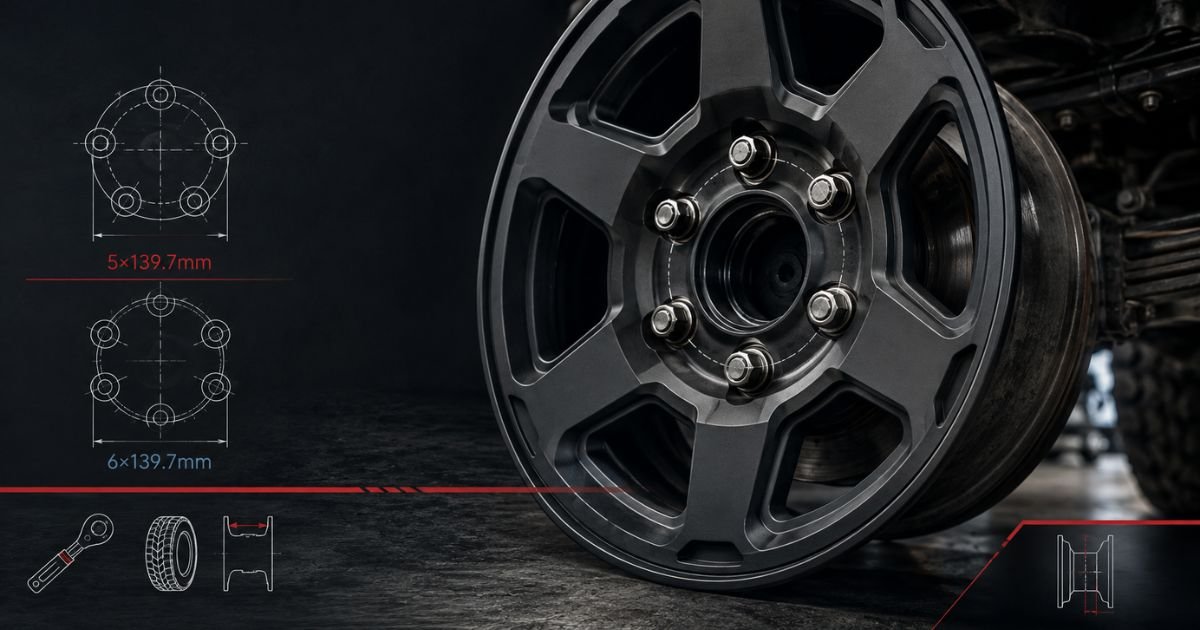
If you’re shopping for aftermarket wheels, the single most important number you need is the Dodge Ram 1500 bolt pattern. Get it wrong, and you’re looking at a wheel that either won’t seat on the hub at all or one that seats improperly and vibrates itself loose at highway speed. This isn’t a small detail — it’s the foundation every other fitment decision is built on.
The tricky part with the Ram 1500 is that the bolt pattern isn’t a single, fixed number across the truck’s entire history. For 25 years it stayed remarkably consistent, and then in 2019 it split into two separate configurations depending on which platform your truck rolled off. That single change has caused more wheel-fitment confusion — and more costly returns for retailers — than almost any other spec change in the truck’s lifetime.
This guide walks through every generation of the Dodge Ram 1500, from 1994 to the current 2026 model year, covering bolt pattern, hub bore, offset, wheel size, and the real-world fitment logic that determines whether a wheel actually belongs on your truck. Whether you’re a distributor stocking inventory or an owner shopping for a new set of rims, the goal here is the same: match the spec to the truck, the first time.
Key Takeaways
- The Dodge Ram 1500 bolt pattern was 5×139.7mm from 1994 through 2018, and it stayed that way on the DS “Classic” trucks built alongside the newer generation through 2024.
- Starting with the 2019 model year, the redesigned Ram 1500 on the DT platform switched to a 6×139.7 mm lug pattern, splitting the lineup into two separate fitment categories.
- Every generation of the Dodge Ram 1500, regardless of lug count, has used the same 77.8mm hub bore.
- Wheel offset on stock trucks runs between +19mm and +25mm, and straying too far outside that range creates rubbing or bearing stress.
- 5-lug and 6-lug Ram 1500 wheels are never interchangeable — this single mix-up causes the majority of return requests in the aftermarket wheel trade.
- Knowing your wheel size, bolt pattern, and hub bore together — not just one spec in isolation — is what actually determines safe, correct wheel fitment.
What is the Dodge Ram 1500 Bolt Pattern?
The bolt pattern, also called the lug pattern or bolt circle, describes two things: how many lug holes the wheel has, and the diameter of the imaginary circle that runs through the center of each one. It’s written as a number-by-number pairing — for example, 5×139.7mm means five lug holes arranged around a 139.7mm circle.
For most of its life, the Dodge Ram 1500 has used a 5×139.7 mm (often written as 5×5.5″) bolt pattern. That held true from the second generation in 1994 all the way through 2018, and it continued on the DS “Classic” trucks Ram kept building alongside the redesigned model through 2024.
Everything changed in 2019. The redesigned Ram 1500, built on the new DT platform, moved to a 6×139.7 mm lug pattern — six lug holes instead of five, spaced around that same 139.7mm circle. Ram made this switch to improve load distribution and structural rigidity on the newer chassis, but it created a hard line in the aftermarket wheel market: pre-2019 trucks and post-2019 DT trucks are no longer wheel-compatible with each other.
“The lug count isn’t a cosmetic detail — it’s a structural spec. A 5-lug wheel physically cannot bolt to a 6-lug hub, and forcing the issue with adapters introduces real safety risk.”
This is why wheel fitment on the Ram 1500 always starts with one question: which platform is this truck built on? Everything downstream — offset, hub-centric rings, wheel width — depends on getting that first answer right.
Why the Lug Count Changed in 2019
Ram split the lineup into two platforms starting in 2019: the DS “Classic,” which is essentially a continuation of the prior-generation truck sold at a lower price point, and the all-new DT, which is the redesigned flagship. The DT’s move to six lugs reflects a heavier-duty hub assembly designed to handle higher payload and towing figures. For retailers, this means two separate SKUs exist for what is nominally “the same truck” depending on model year and trim — a distinction that catches a lot of first-time buyers off guard.
Ram 1500 Bolt Pattern by Generation/Year (1994–2026)
Knowing the Ram 1500 bolt pattern by year is essential because fitment changes are tied to platform generations, not arbitrary model-year updates. Here’s the full breakdown:
Ram 1500 Bolt Pattern by Generation (1994–2026)
| Generation / Years | Bolt Pattern | Hub Bore | Lug Thread | OEM Wheel Sizes |
|---|---|---|---|---|
| 1994–2001 (2nd Gen) | 5×139.7mm | 77.8mm | ½”-20 | 15–16″ |
| 2002–2008 (3rd Gen) | 5×139.7mm | 77.8mm | 14×1.5mm | 17–20″ |
| 2009–2018 (4th Gen) | 5×139.7mm | 77.8mm | 14×1.5mm | 17–20″ |
| 2019–2024 (DS Classic) | 5×139.7mm | 77.8mm | 14×1.5mm | 17–20″ |
| 2019–2026 (DT New Gen) | 6×139.7mm | 77.8mm | 14×1.5mm | 18–22″ |
The takeaway here is straightforward: every Ram 1500 truck built before 2019, plus the DS Classic trucks built in parallel afterward, shares an interchangeable 5×139.7mm bolt pattern. The new-generation DT trucks are a completely separate wheel category with their 6×139.7 mm pattern. For anyone managing aftermarket wheels inventory, this table is effectively your two-bucket sorting system.
1994–2001 Ram 1500 (2nd Gen) Bolt Pattern Specs
The second-generation Ram — the truck that won MotorTrend’s Truck of the Year award — used a 5×139.7mm bolt pattern with a ½”-20 lug thread, a departure from the metric thread sizing used on later trucks. Wheel sizes stayed modest at 15–16 inches, reflecting the tire and suspension technology of the era.
2002–2018 Ram 1500 (3rd/4th Gen) Bolt Pattern Specs
The third and fourth generations kept the same 5×139.7mm bolt pattern but standardized on a 14×1.5mm lug thread, which remains the spec used across every generation since. Wheel sizes expanded to a 17–20 inch range as factory trim levels diversified.
2019–2024 Ram 1500 Classic (DS) Bolt Pattern Specs
The Classic trucks kept the legacy 5×139.7mm pattern intact, giving budget-focused buyers and fleet operators continued access to a well-established, wide-availability wheel category.
2019–2026 Ram 1500 DT Bolt Pattern Specs
The redesigned DT trucks moved to 6×139.7mm across the board, with OEM wheel sizes stretching up to 22 inches on higher trims like the Laramie and Limited.
Complete Specs Explanation
A correct Dodge Ram 1500 bolt pattern match is necessary, but it’s not sufficient on its own. Several other specs work together to determine whether a wheel actually fits right under real driving conditions.
Complete Specs Explanation
| Parameter | 5-Lug Models | 6-Lug DT | Notes |
|---|---|---|---|
| Bolt pattern | 5×139.7mm | 6×139.7mm | Not interchangeable |
| Center bore | 77.8mm | 77.8mm | Hub-centric rings needed if aftermarket bore is larger |
| OEM offset | +19 to +25mm | +19 to +25mm | Positive offset keeps wheels tucked inside the fender |
| Stock wheel width | 7–9 inches | 8–9.5 inches | Wider wheels usually need offset adjustment |
| Lug thread | 14×1.5mm (½”-20 pre-2002) | 14×1.5mm | Conical seat, 60° |
Center Bore & Hub-Centric Fitment
Every generation of the Ram 1500, regardless of lug count, shares a 77.8mm hub bore. This is the hole in the center of the wheel that seats directly against the hub — separate from the lug holes entirely. A properly matched hub bore is what keeps the wheel centered and vibration-free at highway speed; the lugs alone aren’t designed to carry that centering job. When an aftermarket wheel has a larger bore than 77.8mm, a hub-centric ring closes the gap and restores that centered fit.
Lug Nut Torque Spec & Thread Size
The Ram 1500 uses a 14×1.5mm lug thread with a conical, 60-degree seat on every generation since 2002 (earlier trucks used a ½”-20 thread). Factory torque spec is 100–130 ft-lbs, and it’s worth re-torquing after the first 50–100 miles on any newly installed wheel set — thread seating settles slightly under initial load, and a re-check catches that before it becomes a loose-wheel problem.
OEM Offset Range
Stock Ram 1500 wheel offset falls between +19mm and +25mm. Staying inside that window, or close to it, keeps the wheel’s relationship to the suspension and fender close to factory-engineered geometry.
How to Measure Your Ram 1500 Bolt Pattern (DIY Guide)
If you’re not sure which spec your truck has, measuring it yourself takes a few minutes:
- Remove the wheel and lay it face-up, or measure directly on the vehicle with the wheel off.
- Count the lug holes. Five holes means 5×139.7mm-era truck; six means a DT.
- For odd lug counts (5-lug): measure from the center of one lug hole to the farthest edge of the hole directly across from it.
- For even lug counts (6-lug): measure center-to-center between two lug holes directly opposite each other.
- Convert if needed. 139.7mm converts to 5.5 inches — so a reading close to either number confirms the same pattern.
- Cross-check against the year/generation table above rather than relying on the measurement alone, since a slightly worn gauge or measuring error can throw the reading off by a few millimeters.
A dedicated bolt pattern gauge or a good set of calipers makes this far more accurate than eyeballing it with a tape measure.
5×139.7 mm Wheels: Compatibility & Aftermarket Options
The 5×139.7mm bolt pattern covers the widest span of the Ram 1500’s production history — 1994 through 2018, plus the DS Classic trucks built through 2024. That’s three full decades of trucks sharing one wheel category, which is exactly why this segment dominates the aftermarket wheels market for Ram products.
This same bolt pattern also appears on a number of other full-size trucks and SUVs across different manufacturers, which broadens the pool of compatible wheel sizes and designs even further. From a pure fitment standpoint, cross-compatibility within this bracket is strong — the real decision point becomes offset and wheel width rather than the bolt pattern itself.
For off-road-oriented builds, wider, more aggressive wheel designs tend to pair with larger tires and taller sidewalls. For daily-driver or mixed-use trucks, a more balanced offset keeps the ride predictable and the steering geometry close to stock. That flexibility is a big part of why the 5×139.7mm category remains one of the most commercially active segments in the truck wheel market.
6×139.7 mm Wheels: DT Platform Compatibility & Aftermarket Options
The 6×139.7mm pattern is newer to the market, covering only the redesigned DT-platform Ram 1500 trucks from 2019 onward — but it’s also the fastest-growing segment, simply because every new Ram 1500 sold today falls into this bucket. As more of these trucks age into the aftermarket wheel-replacement window, demand for 6×139.7mm wheels is climbing steadily.
Unlike the older 5-lug pattern, this six-lug configuration is newer to the broader truck market, so buyers should confirm compatibility carefully rather than assuming a “5-lug-adjacent” wheel will work. Aftermarket options in this bracket increasingly include larger 18–22 inch diameters, reflecting the factory wheel sizes already standard on higher DT trims.
Wheels Size for Ram 1500
Wheel size affects ride comfort, tire selection, and overall driving character more than most buyers expect going in.
Wheel Size for Ram 1500
| Wheel Size | Ride Comfort | Tire Availability | Best Use Case |
|---|---|---|---|
| 17″ | Highest | Widest off-road (A/T, M/T) | Off-road / overlanding |
| 18″ | Balanced | Good mix of A/T and highway | Daily driving + light off-road |
| 20″ | Lower | Street-focused | Urban / performance / towing |
| 22″ | Lowest | Low-profile, performance-oriented | Show / street builds |
17-Inch Wheels for Ram 1500
Seventeen-inch wheel sizes remain the go-to choice for off-road-focused trucks. The taller sidewall that comes with a smaller wheel diameter absorbs impacts better and holds up longer against rough terrain — a genuine functional advantage, not just a budget-friendly one.
18-Inch Wheels for Ram 1500
An 18-inch setup splits the difference nicely: solid tire availability across both all-terrain and highway-focused options, with a ride quality that stays comfortable for daily use without sacrificing much capability.
20–22-Inch Wheels for Ram 1500
Larger diameters shift the priority toward road presence and handling response. They look sharper and corner more confidently on pavement, but the tradeoff is a firmer ride and pricier tire replacements down the road.
How Offset Affects Fitment, Stance & Clearance
Wheel offset describes the distance between a wheel’s mounting surface and its centerline, measured in millimeters. A positive offset pulls the wheel in toward the truck, tucking it closer to the suspension. A negative offset pushes it outward, away from the truck.
Positive Offset
Sticking close to the factory +19mm to +25mm range keeps the wheel in a more engineered position — less stress on suspension components, more predictable steering feel, and a look that stays close to factory-stance.
Negative Offset
Going negative widens the stance and gives the truck a more aggressive look, which is popular on show builds and lifted trucks. The tradeoff is real, though: too much negative offset increases the chance of tire rub against the fender, adds load to the wheel bearings, and can accelerate suspension wear over time.
Tire Size Compatibility by Generation
Wheel diameter and tire size move together, and matching them correctly protects both ride quality and the truck’s speedometer accuracy. Earlier 15–16 inch wheel setups typically paired with taller sidewall tires, while modern 20–22 inch wheel sizes run lower-profile rubber to maintain a similar overall rolling diameter. When plus-sizing a wheel — going from 17″ to 20″, for example — always recalculate the tire’s aspect ratio so the total tire height stays close to factory spec. Getting this wrong throws off gearing, fuel economy, and even ABS/traction control calibration on newer trucks.
Choosing the Wheels Based on Use Case
Choosing Wheels Based on Use Case
| Use Case | Recommended Size | Offset Range | Wheel Type |
|---|---|---|---|
| Off-road / overlanding | 17″ | +10 to 0 | Flow-form or forged |
| Daily driving / mixed | 18″ | +19 to +25 | Cast or flow-form |
| Towing / heavy duty | 18–20″ | +19 to +25 | Forged or reinforced |
| Urban / show stance | 20–22″ | -12 to 0 | Cast or flow-form |
Off-road and overlanding builds benefit from durable, moderately-offset wheels that leave room for taller sidewall tires. Daily-driving setups favor a balanced approach — consistent handling and comfortable highway manners without sacrificing capability. Towing and fleet use call for reinforced construction where load stability matters more than stance. Show-focused builds lean into negative offset for a wider, more dramatic look, accepting the added maintenance that comes with it.
Aftermarket Wheels Strategy for Distributors & Retailers
Stocking Ram 1500 wheels intelligently starts with separating inventory by bolt pattern first, then by use case. Here’s the fitment verification workflow worth building into any sales process:
- Identify generation and bolt pattern — pre-2019/Classic means 5×139.7mm; 2019+ DT means 6×139.7mm. This step is non-negotiable.
- Select wheel size based on use — 17″ for off-road, 18″ for mixed use, 20″+ for street or towing.
- Choose offset — stick to +19 to +25mm for safety-first fitment, or go negative only when the buyer understands the tradeoffs.
- Verify center bore — confirm 77.8mm, and stock hub-centric rings for any aftermarket wheel with a larger bore.
- Confirm construction and load rating — cast for budget-conscious buyers, flow-formed for the best value-to-strength ratio, forged for heavy-duty or towing applications.
Demand has been trending upward in the off-road segment specifically, as more trucks get configured for overlanding and mixed-terrain use. For wholesale truck wheels, matching manufacturing type to customer intent — cast, flow-formed, or forged — does more for long-term sales efficiency than chasing trend-driven finishes alone.
TPMS & Lug Nut Compatibility Notes
Swapping wheels doesn’t necessarily mean swapping TPMS sensors — most factory sensors transfer over to compatible aftermarket wheels without issue, as long as the valve stem style matches. Lug nuts deserve equal attention: aftermarket wheels sometimes require a different seat type (conical vs. ball seat) than the factory nuts provide, and using the wrong seat type prevents the wheel from torquing down evenly, even when the bolt pattern itself is correct.
Common Fitment Mistakes to Avoid
Common Fitment Mistakes to Avoid
| # | Mistake | Root Cause | Impact |
|---|---|---|---|
| 1 | Wrong bolt pattern | Confusing 5×139.7 with 6×139.7 | High — immediate return |
| 2 | Incorrect offset | Ignoring the OEM +19 to +25mm range | High — rubbing / return |
| 3 | Oversized center bore | No hub-centric rings on aftermarket wheels | Medium — vibration complaint |
| 4 | Wrong wheel width | Wide wheels without offset compensation | Medium — clearance issue |
| 5 | Cross-generation assumption | Thinking 5-lug fits a DT model | High — unsafe mounting |
Most wheel fitment failures trace back to one of these five oversights, not some obscure edge case. Double-checking bolt pattern and offset before an order ships eliminates the majority of avoidable returns.
Real-World Fitment Scenarios
Off-Road Build
A 17-inch wheel paired with an all-terrain tire gives the sidewall flexibility and ground clearance overlanding builds need. Function takes priority over aesthetics here, and the wider tire profile this setup allows is exactly why 17″ remains the dominant off-road choice.
Urban Daily Driver
A 20-inch setup with low-profile tires shifts priorities toward road handling and visual presence. Control and responsiveness matter more than outright ride softness in this context, and the setup rewards that tradeoff with sharper cornering.
Towing & Fleet Use
Structural strength and consistent load capacity matter most here. A reinforced wheel paired with load-rated tires handles repeated weight cycling far better than a lighter, style-focused setup, which is exactly what commercial and fleet applications demand.
Ram 1500 vs. Ram 2500/3500 Bolt Pattern — Key Differences
It’s a common assumption that heavier-duty Ram trucks share wheels with the 1500 — they don’t. The Ram 2500 and 3500 use an 8×165.1mm bolt pattern, built around eight lugs instead of five or six, reflecting the higher load capacity of those trucks. A Ram 1500 wheel will not fit a 2500 or 3500, and vice versa, regardless of how similar the trucks look side by side. Always confirm the model line, not just the “Ram” badge, before sourcing wheels.
Frequently Asked Questions
What Dodge has a 5×5.5 bolt pattern?
The Dodge Ram 1500 (1994–2018, plus DS Classic) uses 5×5.5.
What is a Dodge Ram 1500 5 lug bolt pattern?
It’s 5×139.7mm — five lugs on a 139.7mm circle.
Will 6 lug Chevy rims fit a Dodge Ram 1500?
No — Chevy’s 6-lug spacing differs from the Ram’s 6×139.7mm pattern.
Do Jeep and Dodge Ram have the same bolt pattern?
No, most Jeeps use 5×114.3mm, different from the Ram’s pattern.
Can 5×139.7 wheels fit all Ram 1500 models?
No, from 2019 onward, Ram splits into two platforms: DS Classic trucks keep the 5×139.7mm five-lug pattern, while DT trucks use 6×139.7mm. Always confirm the platform and model year first.
What’s the best wheel size for off-road use on a Ram 1500?
Generally, 17-inch wheels from reputable manufacturers offer the best balance of sidewall flexibility, tire availability, and durability for off-road use.
Do bigger wheels affect towing capacity on a Ram 1500?
Larger wheels, typically 20 inches and up, pair with lower-profile tires that flex less, which can affect ride comfort under towing load even though the truck’s rated capacity itself doesn’t change.
How do I decide between forged, flow-formed, or cast wheels?
It comes down to budget and use case. Cast wheels are the most affordable and widely available. Flow-formed wheels offer a stronger, lighter middle ground. Forged wheels deliver the best strength-to-weight ratio, making them the top choice for heavy-duty or towing applications.
Conclusion
Getting the Dodge Ram 1500 bolt pattern right is the foundation of safe, long-lasting wheel fitment — and with this truck’s history split cleanly into 5-lug and 6-lug eras, that foundation matters more than ever. Match the generation to the correct bolt pattern first, then layer in wheel size, wheel offset, and center bore to round out a complete, accurate fitment decision. Skip the assumptions, verify against the model year, and the rest of the process — whether you’re stocking inventory or picking a set for your own truck — falls into place with far fewer surprises.
15 common things that weigh 300 grams
16 common things that weigh 500 grams
22 common things that weigh 20 grams
15 common things that weigh 10 grams
20 common things that weigh 1 gram
18 common things that weigh 100 grams
20 common things that are 10 inches long
18 common things that are 16 inches long
14 common things that are 40 inches long
things that are 40 inches long
20 common things that are 15 inches long
18 common things that are 12 inches long
things that are 40 inches long
18 common things that are 7 inches long
18 common things that are 18 inches long
16 common things that are 4 inches long
20 common things that are 8 inches long
19 common things that are 3 inches long
15 common things that are 20 feet long
18 common things that are 13 inches long
17 common things that are 20 inches long
17 common things that are 6 inches long
17 common things that are 5 inches long
13 common things that are 2 inches long
20 common things that are 24 inches long
20 common things that are 30 inches long
20 common things that are 36 inches long
15 common things that are 59 inches long
20 common things that are 19 inches long
20 common things that are 26 inches long
20 common things that are 100 inches long
20 common things that are 9 inches long
20 common things that are 57 inches long
20 common things that are 34 inches long
20 common things that are 96 inches long
20 common things that are 5.7 inches long
20 common things that are 1.375 inches long
20 common things that are 1.25 inches long
25 common things that are 11 inches long
20 common things that are 1 inch long
20 common things that are 2.4 inches long
20 common things that are 2.75 inches long
20 things that are 102 inches long
20 common things that are 42 inches long
20 common things that are 55 inches long
15 Common Things That Weigh 12 Kg (2026 Real-World Comparisons)
20 Common Things That Weigh 15 kg — 2026 (Real-World Comparisons)
15 Common Things That Weigh 100 Kg (2026 Plus Exact Conversions)
20 Common Things That Weigh 30 kg — (2026 Real-World Comparisons)
15 Things That Weigh 70 Kg (2026 Real-World Comparisons)
15 Common Things That Weigh 25 kg – 2026 (Real-World Comparisons)
How Heavy Is 50kg? 10 Things That Match It Perfectly in 2026
How Heavy Is 40kg? 10 Things That Match It Perfectly in 2026
How Much Is 10kg? 15 Common Things That Weigh 10 Kilograms (2026)
How Heavy Is 20kg? 10 Things That Match It Perfectly in 2026
15 Things That Weigh 50 Ounces (Everyday Examples, 2026)
How Much Is 7 Ounces? 20 Most Common Things That Weigh About 7 Ounces
15 Common Things That Weigh 15 Ounces (With Real Life Examples)
20 Common Things That Weigh 10 Ounces (With Real Life Examples)
10 Common Things That Weigh 2 Ounces (With Pictures & Comparisons)
8 Common Things That Weigh 3 Ounces (With Real Life Examples)
15 Common Things That Are 30 Feet Long – 2026 (With Real-Life Comparisons)
15 Common Things That Are 300 Feet Long – 2026 (Real-Life Examples)
15 Common Things That Weigh 50 Lbs (50 Pounds) 2026 Everyday Objects
15 Common Things That Weigh 20 Lbs (With Everyday Comparisons)
15 Common Things That Weigh 10 Lbs (With Everyday Examples)
15 Common Things That Weigh 10 Pounds (2026)
15 Common Things That Are 50 Feet Long – 2026 (With Real-Life Comparisons)
How Far Is 500 Feet? 15 Most Common Things That Are 500 Feet Long
How Long Is 25 Feet? 20 Most Common Things That Are Exactly (or Super Close to) 25 Feet Long
20 Common Things That Are 44 cm Big (With Real-Life Examples)
20 Common Things That Are 2 cm Big (With Real-Life Examples)
20 Common Things That Are 5 cm Big: A Complete Size Guide
20 Common Things That Are 20 CM Big (With Inch Conversions)
20 Common Things That Are 30 cm Big (With Inch Conversions)
How Big Is A Centimeter? 18 Everyday Objects That Show You Exactly
Sig Fig Calculator: The Fast, Accurate Way to Count and Round Significant Figures
What Is Width? A Complete Guide to Understanding Width in Math and Everyday Life
How Long Until 3:15 PM? Live Timer Check the Exact Time Left Instantly
20 Common Things That Are 10 Meters Long (With Visual Comparisons)
20 Common Things That Are 3 Meters Long (With Easy Comparisons)
How Far Is 500 m Really? 20 Famous Things & Everyday Distances That Equal About 500 Meters Long
How Long Is 20 Meters In Comparison To 20 Everyday Objects
How Long is 30 Meters? 25 Most Common Distances And Things That Are 30 Meters Long -2026
20 Common Things That Are 2 Meters Long/Tall (2026)
How Long Is 100 Meters? 15 Common Things That Are 100 Meters Long
How Long Is 5 Meters? 15 Common Things That Are 5 Meters Long
How Long Is 50 Meters? 15 Common Things That Are 50 Meters Long
How Long Is 4 Meters? 15 Common Things That Are 4 Meters Long
How Long Is 300 Meters? 15 Common Things That Are 300 Meters Long
Karen Backfisch-Olufsen: The Story of Jim Cramer’s Ex-Wife
Amy Sherrill: The Real Story Behind Tim Duncan’s Ex-Wife
Mary Carey Van Dyke: The Story Behind Barry Van Dyke’s Wife
Matthew Mario Rivera: The Story Behind Kasie Hunt’s Husband
Constantine Yankoglu: The Story of Patricia Heaton’s First Marriage
Gatorade Bottle Dimensions: A Complete Guide With Facts
Arizona Tea Can Dimensions: Size, Height & Width Guide With Facts
How Long Is 5 Inches? 20 Everyday Objects That Are 5 Inches Long With Pictures
How Long Is 7 Inches? 20 Common Things That Are 7 Inches Long
20 Common Things That Measure 50 Feet Long or Big With Pics
How Long Is 2 Feet? 12 Common Things That Are 2 Feet Long With Pics
How Long Until 3 PM? The Ultimate Live Countdown Guide
Paula Ebben Age 2026: Husband, Family, Networth Bio and Secrets
Lolo Wood Net Worth: Age, Height, Career, Ridiculousness, Wild N Out & Motherhood (2026)
Dino Guilmette: A Deep Dive Into His Life, Career, and Personal Story
BigXthaPlug Age: His Net Worth, Height, Weight, and Life Story
Who Is Jeremy Yaffe? The Quiet Life Behind Alan Arkin’s Early Years
Pringles Can Dimensions: Size, Height & Diameter In Detailed 2026
Metric Socket Sizes Chart & Conversion Guide 2026
Metric Socket Sizes Chart & Conversion Guide In Detailed 2026
Per Stay Vs Per Night: Which Accommodation Pricing Option Is Cost-Effective?
How Tall Is the iPhone 16 in cm? (Official Size Guide) In Detailed
2×8 Actual Size: 1.5 in × 7.25 in (38 mm × 184 mm) — The Complete Guide
Lauren Compton: Early Life, Background, Wikipedia, Grokipedia, and Career (2026)
Brandi Belle: IMDb Profile, Early Life, Career, Personal Life and Grokipedia Guide
Matte Babel Wikipedia: Net Worth, Kids, Early Life, and Grokipedia Facts
Velicity Von: Early Life, Net Worth, Career, and Her Grokipedia Profile
What Is Erikkapost Com? The Honest Guide to Features, Pros and How It Works in 2026 Magazine Aura
SFM Compile: A Comprehensive Overview of Source Filmmaker Model Compilation (2026) Magazine Aura
How Long Until 2 PM? Live Countdown, Time Zones, and Manual Calculation Explained
How Long Until 3:30 PM? Live Countdown Timer, Calculator & Complete Guide
How Long Until 2:30 PM? Live Countdown Timer
How Long Until 2:30 PM? See Live Now
What Time Was It 15 Hours Ago? Live Countdown
What Time Was It 11 Hours Ago? Live Countdown & Instant Time Calculator
King Size Bed Dimensions: The Complete Size Guide
Everything You Need to Know About Crayola Air Dry Clay: A Complete Guide
Joylette Goble: The Untold Story of Katherine Johnson’s Daughter
Sharon Mobley Stow: The Untold Story of Jim Acosta’s Ex-Wife

Hi, I’m John Wick, the admin at Magazineaura.com. I make measurements simple and easy to understand, from bed sizes to everyday length conversions. Clear guides. Accurate dimensions. No confusion.