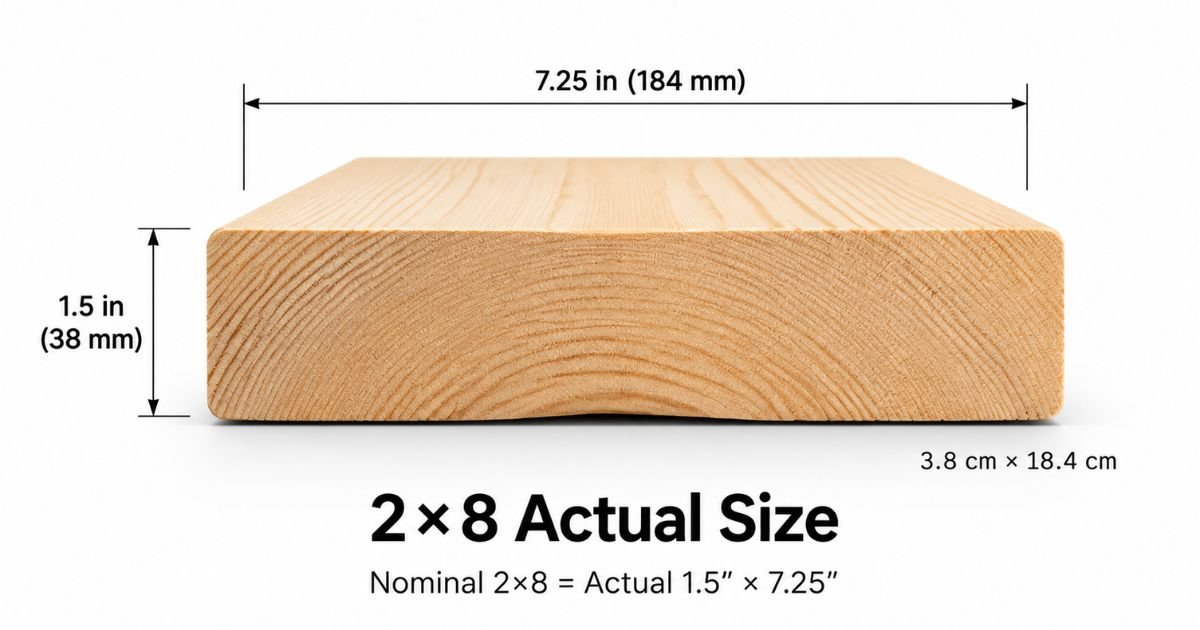
If you’ve ever grabbed a “2×8” board at the lumber yard and measured it, you probably noticed something odd: it’s not 2 inches by 8 inches. The 2×8 actual size is 1.5 inches × 7.25 inches (38 mm × 184 mm).
That’s the real, finished size you’ll get once the board leaves the mill. The “2×8” label is just a nickname — a nominal size — and once you understand why the numbers don’t match, buying and building with framing lumber gets a whole lot easier.
This guide breaks down the actual measurements, why they differ from the label, how a 2×8 compares to other dimensional lumber, and what it’s typically used for on real job sites across the U.S.
Quick Dimensions
Here’s the fast answer, if that’s all you came for.
Actual 2×8 Lumber Dimensions
| Label | Inches | Millimeters | Centimeters |
|---|---|---|---|
| 2×8 Actual Size | 1.5″ × 7.25″ | 38 × 184 mm | 3.8 × 18.4 cm |
| 2×8 Thickness | 1.5″ | 38 mm | 3.8 cm |
| 2×8 Width | 7.25″ | 184 mm | 18.4 cm |
These are the finished dimensions you’ll find on a standard 2×8 sold at any U.S. lumber yard or home center. The length, though, isn’t affected by this shrinkage — an 8-foot 2×8 really does measure close to 8 feet. It’s only the thickness and width that shrink from the nominal size.
Also searched as: 2×8 dimensions, 2×8 actual measurement, 2×8 true size, 2×8 real size, and 2×8 size in mm.
Nominal vs Actual (Why Sizes Are Smaller)
Here’s the part that trips up a lot of first-time buyers: the nominal size is what the board is called before it’s processed. A 2×8 starts life as a rough-cut board that’s genuinely close to 2 inches by 8 inches. But it doesn’t stay that way.
Two things happen between the sawmill and the store shelf:
- Drying — Green lumber holds a lot of moisture. As it dries, wood fibers shrink, and the board loses size across its width and thickness.
- Surfacing (S4S) — Most framing lumber is “Surfaced on 4 Sides,” meaning it’s planed smooth on all faces. That planing shaves off additional material to give a clean, splinter-free finish.
By the time both steps are done, a rough 2×8 becomes a smooth, finished 1.5″ × 7.25″ board. As one longtime lumber yard employee put it on a woodworking forum:
“Nobody’s cheating you on wood. The 2×8 is just the name of the rough board before it’s dried and planed — the tag follows tradition, not the tape measure.”
This system is standard across North American softwood framing lumber and has been the industry norm for decades under the American Softwood Lumber Standard. Every 2×8 you buy — whether in Texas, Oregon, or Maine — will follow the same finished dimensions.
One quick note: sheet goods like plywood shrink differently. Sanding during manufacturing removes material too, so a 3/4″ sheet often measures closer to 23/32″. It’s a separate process from how solid framing lumber gets its actual measurements.
Compare to Other Common Sizes
Once you know the pattern, comparing lumber sizes gets easy. The nominal size always rounds up from the actual measurements, and thickness stays consistent at 1.5″ across most standard boards.
Nominal vs. Actual Lumber Sizes
| Nominal | Actual (in) | Actual (mm) |
|---|---|---|
| 1×8 | 0.75 × 7.25 | 19 × 184 |
| 2×4 | 1.5 × 3.5 | 38 × 89 |
| 2×6 | 1.5 × 5.5 | 38 × 140 |
| 2×8 | 1.5 × 7.25 | 38 × 184 |
| 2×10 | 1.5 × 9.25 | 38 × 235 |
| 2×12 | 1.5 × 11.25 | 38 × 286 |
| 4×4 | 3.5 × 3.5 | 89 × 89 |
Notice that a standard 2×8 shares the same 1.5″ thickness as a 2×4, 2×6, and 2×10 — only the width changes as the nominal number climbs. This consistency in framing lumber dimensions makes it easy to mix board sizes in the same project without worrying about mismatched thickness.
What Is a 2×8 Used For?
A 2×8 sits in a sweet spot: thicker and stronger than a 2×6, but lighter and cheaper than a 2×10. You’ll commonly find it in:
- Floor and ceiling joists
- Deck framing and deck joists
- Door and window headers
- Stair stringers
- Roof rafters on shorter spans
- General workshop and outdoor builds
2×8 Weight and Strength
Weight depends on species and moisture content, but a rough estimate for an 8-foot standard 2×8 in SPF (spruce-pine-fir) runs around 15–20 lbs, with Southern Yellow Pine running heavier due to density. For structural spans — like joists carrying a floor load — always check your local building code or a certified span table rather than guessing. Actual lumber dimensions matter here because even a slight variance can affect load calculations on critical builds.
Pressure-Treated 2×8 vs Standard Lumber
A pressure treated 2×8 finishes at the same nominal and actual dimensions as untreated lumber. The treatment process injects chemical preservatives into the wood to resist rot and insects, but it doesn’t change the milling standard.
One thing to watch: PT lumber is often sold “wet” straight from the treatment plant. As it dries in your yard or garage, it can shrink slightly further and sometimes warp. If precision matters — say, for a deck with tight board spacing — let treated lumber acclimate for a few days before final cuts.
How to Measure a 2×8 Yourself
Don’t trust the label alone. Grab a tape measure and check the width and thickness directly. Expect minor variation, sometimes up to 1/16″, between boards or species. If you’re doing tight joinery work, always measure your actual lumber before cutting — it’s the single best habit for avoiding costly mistakes.
Quick Answers
How big is a 2×8 actual size?
1.5 inches by 7.25 inches, finished dimensions.
What’s the true size of a 2×8?
1.5″ × 7.25″, or 38 × 184 millimeters.
How thick is a 2 by 8?
Exactly 1.5 inches thick, same as most framing lumber.
What does a 2×8 look like?
Long rectangular board, smooth-planed, noticeably wider than thick.
Conclusion
To sum it up: the 2×8 actual size is 1.5 inches × 7.25 inches (38 mm × 184 mm), not the 2×8 inches the name suggests. That gap comes from drying and surfacing, a standard part of how North American softwood lumber is milled. Once you understand nominal vs. actual sizing, buying and building with dimensional lumber becomes far less confusing — and a lot more predictable.
Arizona Tea Can Dimensions And Gatorade Bottle Dimensions And Soda Can Dimensions And Red Bull Can Dimensions And Dimensions of Monster Can And Coke Can Dimensions And Pokémon Card Dimensions Gatorade Bottle Dimensions And Arizona Tea Can Dimensions

Hi, I’m John Wick, the admin at Magazineaura.com. I make measurements simple and easy to understand, from bed sizes to everyday length conversions. Clear guides. Accurate dimensions. No confusion.