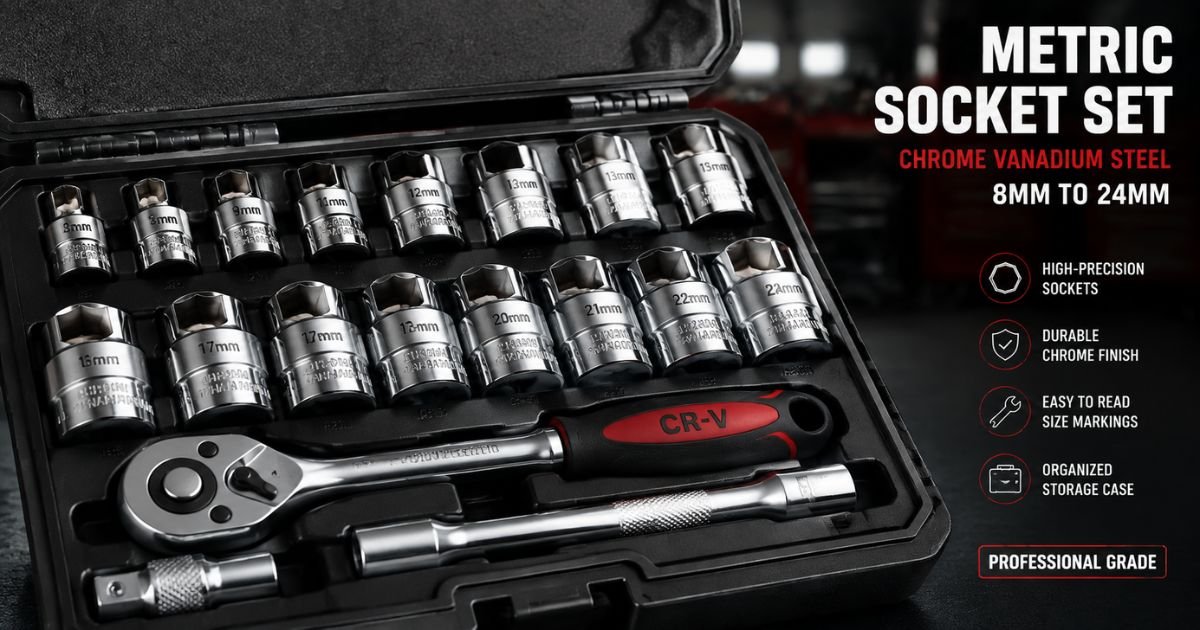
Metric socket sizes follow the International System of Units and are measured in millimeters, ranging from tiny 4mm sockets up to heavy-duty 50mm+ sizes. Understanding metric socket sizes is essential for automotive maintenance, mechanical repair, and general upkeep around the house or shop. This comprehensive socket size chart and conversion guide breaks down standard socket dimensions, shows you how to convert between systems, and helps you pick the right metric socket set for your work in 2026.
For US-based mechanics and DIYers, this matters more than ever. Import vehicles, modern appliances, and much of today’s industrial machinery are built entirely around metric fasteners, while older domestic vehicles and legacy equipment still rely on standard socket sizes. A well-rounded toolbox in 2026 needs to speak both languages fluently.
Standard Metric Socket Sizes in Order
The most common metric socket sizes follow a logical, easy-to-learn progression measured in millimeters. Standard metric sockets typically span from 4mm to 50mm, with the most frequently used sizes being 8mm, 10mm, 12mm, 13mm, 14mm, 15mm, 17mm, 19mm, and 22mm. A professional-grade metric socket set usually includes 4mm, 4.5mm, 5mm, 5.5mm, 6mm, 7mm, 8mm, 9mm, 10mm, 11mm, 12mm, 13mm, 14mm, 15mm, 16mm, 17mm, 18mm, 19mm, 20mm, 21mm, 22mm, 24mm, 27mm, 30mm, 32mm, and larger sizes for heavy-duty applications.
Unlike fractional inch standard measurements, socket dimensions in millimeters offer precise, unambiguous sizing that removes a lot of guesswork. Each socket size corresponds directly to the bolt or nut diameter it’s built for, which makes socket sizing far simpler once you know the system. The progression isn’t always in whole millimeters, either — many manufacturers include half-sizes like 4.5mm, 5.5mm, and 11.5mm for specialized fasteners common on European and Asian vehicles sold throughout the US market.
“Once you understand that metric sockets map directly to bolt diameter, size selection stops being guesswork,” is a sentiment echoed by nearly every veteran technician who’s made the switch from fractional-only toolboxes.
Most Common Metric Socket Sizes for Everyday Use
The workhorse sizes in any metric socket set are 10mm, 12mm, 13mm, 14mm, 15mm, 17mm, and 19mm. These seven sizes alone handle roughly 80% of everyday automotive maintenance and mechanical tasks. The 10mm socket has earned a bit of a reputation among mechanics for being the one that always seems to disappear — it’s used so frequently on engine covers, brackets, and accessory bolts that it tends to wander off mid-job.
For general household repairs, a basic set covering 8mm through 19mm metric socket sizes will handle the overwhelming majority of scenarios you’ll run into:
- 8mm – small appliance panels, bicycle components
- 10mm – battery terminals, interior trim, brackets
- 12mm–13mm – engine covers, alternator bolts
- 14mm–15mm – suspension hardware, wheel components
- 17mm–19mm – larger bolts, some wheel lug nuts
Large Metric Socket Sizes for Heavy-Duty Applications
Heavy-duty applications call for larger metric socket sizes ranging from 22mm all the way up to 50mm or beyond. Common large sizes include 22mm, 24mm, 27mm, 30mm, 32mm, 36mm, 41mm, 46mm, and 50mm. These sockets are essential for truck maintenance, industrial machinery, and construction equipment, where fasteners are built to handle far greater torque loads than anything found on a passenger vehicle.
Professional mechanics who service commercial vehicles typically invest in a comprehensive metric socket set that reaches into these larger dimensions specifically for axle nuts, suspension components, and hydraulic fittings. Skipping this range means turning to pipe wrenches or adjustable tools that risk rounding off expensive, hard-to-replace fasteners.
Metric to Standard Socket Conversion Guide
Converting between metric to standard socket conversion requires understanding one key fact: the measurements aren’t always exact equivalents, even when they look close on paper. While some sizes line up almost perfectly, others have no reliable substitute at all. The most accurate approach to metric vs standard conversion involves knowing precisely which sizes can stand in for one another in an emergency, and which absolutely cannot.
For example, a 10mm socket is only approximately equivalent to a 3/8-inch socket — the 10mm is actually slightly larger, measuring 0.394 inches compared to 0.375 inches for the 3/8-inch size. That 0.019-inch gap seems tiny, but on a worn or already-rounded fastener, it’s enough to cause the socket to slip.
Most professional mechanics in the US maintain socket collections in both systems because modern vehicles frequently mix the two. Import vehicles predominantly use metric fasteners, while older American vehicles typically rely on imperial sockets and fractional measurements. A well-stocked toolbox should include both systems so you’re never forcing an ill-fitting socket onto a fastener just because it’s the only one on hand.
Popular Metric to SAE Socket Equivalents
Several metric socket sizes have close SAE sockets equivalents that work acceptably as substitutes in a pinch. Here’s how the most common ones stack up:
| Metric Size | Closest SAE Equivalent | Notes |
|---|---|---|
| 8 mm | 5/16-inch | Close, usable substitute |
| 10 mm | 3/8-inch | Slightly larger, common substitute |
| 11 mm | 7/16-inch | Acceptable emergency fit |
| 12 mm | 15/32-inch | Rare SAE size, limited availability |
| 13 mm | 1/2-inch | Very close fit |
| 14 mm | 9/16-inch | Close but not exact |
| 15 mm | 19/32-inch | Rare SAE size |
| 16 mm | 5/8-inch | Close, usable substitute |
| 17 mm | 11/16-inch | Close fit |
| 18 mm | 23/32-inch | Rare SAE size |
| 19 mm | 3/4-inch | Very close fit |
However, forcing an incorrect size — even one that’s “close enough” — can damage fasteners or round off corners, turning a five-minute job into a much longer one involving extraction tools.
When Exact Conversion Isn’t Possible
Certain metric socket sizes have no close standard socket sizes equivalent, which makes owning the proper tool genuinely essential rather than optional. Sizes like 9mm, 21mm, 22mm, and 24mm simply don’t have an acceptable SAE substitute. Attempting to force the nearest standard size onto these fasteners commonly results in rounded corners, stripped threads, or outright damaged components that are expensive to replace.
Investing in a complete metric socket set removes the guesswork — and the risk — that comes from improvising with the wrong size. If you regularly work on import vehicles or modern equipment, treat this as non-negotiable rather than a nice-to-have.
Socket Size Chart: Metric and Standard Comparison
A thorough socket size chart comparing metric and standard systems reveals just how different the two measurement philosophies really are. While metric sizes follow a clean, logical millimeter progression, standard measurements rely on fractional inches that don’t always translate directly into round numbers. Understanding both systems side by side prevents costly confusion when working on mixed-fastener assemblies, which are increasingly common in US garages and workshops.
Professional-grade socket size charts typically include decimal equivalents for precise, apples-to-apples comparisons. This detail becomes invaluable when you need to know, quickly, whether a socket will actually fit or whether you’re better off reaching for the correct metric to standard socket conversion. Technicians working on international equipment — where metric and SAE fasteners can appear on the very same assembly — reference these charts constantly.
Creating Your Personal Socket Reference Chart
Building your own socket size reference improves efficiency and cuts down on costly mistakes over time. Start by listing the sizes you use most often, note their decimal equivalents, and record which substitutions have actually worked for you in the field versus which ones are theoretical only. Many professionals laminate a small socket guide card showing metric socket sizes next to their closest SAE equivalents for fast reference during repairs.
A good personal reference chart should include:
- Your top 10 most-used metric sizes
- Decimal-inch equivalents for each
- Verified safe SAE substitutes (and a clear “no substitute” flag where none exists)
- Notes on which vehicles or equipment each size applies to
Digital Socket Size References and Apps
Modern smartphone apps now provide instant metric to standard socket conversion capabilities, cutting down on guesswork out in the field or under a vehicle. These digital tools often layer in visual size guides, thread pitch information, and torque specifications alongside the raw conversion data. Increasingly, professional mechanics use these apps as a companion to their physical socket size chart, especially when working on equipment they don’t service every day.
Choosing the Right Metric Socket Set
Selecting the right metric socket set comes down to your specific applications, how often you’ll use it, and your budget. Entry-level sets typically cover the most common sizes from 8mm to 19mm, while professional-grade sets extend from 4mm all the way to 50mm or beyond. Quality considerations worth weighing include socket material — chrome vanadium versus chrome molybdenum — along with finish durability and the manufacturer’s warranty coverage.
The best metric socket sets for 2026 feature high-visibility, laser-etched size markings, corrosion-resistant finishes, and organized storage systems that keep every socket exactly where it belongs. Professional-grade tool kits include both standard-depth and deep sockets in each size, plus universal joints and extensions. Look for sets offering 1/4-inch, 3/8-inch, and 1/2-inch drive sizes together to maximize versatility across different torque requirements and clearance situations.
Essential Features in Modern Metric Socket Sets
Today’s metric socket sets pack in several features designed to boost productivity and keep your socket collection organized:
- High-contrast markings that stay legible even under oil and grime
- Magnetic rails that hold sockets in place during use
- Individual storage cases with dedicated holders to prevent lost pieces
- Lifetime warranties and replacement guarantees for professional-grade use
Case study: A small independent repair shop in Ohio switched from a mismatched collection of standalone sockets to a single organized metric socket set with a magnetic rail system. The shop reported cutting average job setup time by several minutes per repair simply because technicians weren’t hunting for missing sizes — a small change with a real impact on daily throughput.
Budget vs Professional Metric Socket Options
Budget metric socket sets typically run $20–$60 and cover the basics for occasional, light-duty use. Professional sets cost $100–$500 or more, offering comprehensive size ranges and noticeably superior materials built to withstand daily wear. Mid-range options in the $60–$150 bracket often deliver the best overall value for serious DIY enthusiasts and light professional work.
| Tier | Price Range | Best For |
|---|---|---|
| Budget | $20–$60 | Occasional, light-duty use |
| Mid-range | $60–$150 | Serious DIY, light professional |
| Professional | $100–$500+ | Daily professional use |
Consider how often you’ll actually reach for these tools — professionals benefit from investing in higher-quality metric socket sizes that hold tight tolerances and withstand years of daily use without rounding off internally.
Deep Sockets vs Regular Metric Sockets
Understanding the difference between deep sockets and regular sockets improves tool selection for specific jobs. Deep sockets, typically 1.5 to 2 times longer than standard sockets, are built to accommodate long threaded rods, recessed bolts, and nuts with extended threads that a shallow socket simply can’t reach. Regular sockets, by contrast, work better in confined spaces where clearance is tight and offer better control for precision applications.
A quality metric socket set includes both depths in the common sizes because each serves a genuinely distinct purpose. Deep sockets prove essential for suspension work, engine bay applications, and anywhere a bolt extends well beyond the nut face. Regular sockets offer superior control for precision tasks and fit into tight spaces where deep sockets simply won’t have the clearance to work.
Metric Socket Applications by Industry
Different industries lean on specific metric socket sizes depending on their equipment and fastener standards. Automotive technicians primarily use 8mm through 22mm sockets for the vast majority of passenger vehicle work, while heavy equipment mechanics need the full range up to 50mm or larger. Electronics and precision equipment work often calls for the smallest sizes, from 4mm to 8mm, for delicate component access where a larger socket simply won’t fit.
| Industry | Common Size Range | Typical Use |
|---|---|---|
| Automotive Maintenance | 8 mm–22 mm | Engine, suspension, wheels |
| Electronics / Precision | 4 mm–8 mm | Delicate component access |
| Construction / Industrial | 22 mm–50 mm+ | Heavy machinery, structural bolts |
| HVAC | 10 mm–19 mm | Ductwork, component installation |
Understanding these industry-specific patterns helps professionals build a metric socket set suited to their actual work environment rather than a generic one-size-fits-all kit. Construction equipment maintenance demands robust large sockets, HVAC technicians need mid-range sizes for ductwork and installation work, and each field has developed its own standard practices shaped by the fasteners its equipment actually uses.
Frequently Asked Questions
Is 9/16 the same as 14mm?
No — 9/16-inch equals about 14.29mm, slightly larger than 14mm.
Is a 3/8 socket the same as a 10mm?
No — 3/8-inch equals about 9.53mm, smaller than a 10mm socket.
Is 10mm metric or standard?
10mm is metric, part of the International System of Units.
What are the sizes of metric nuts?
Metric nuts range roughly M4 (7mm hex) through M20 (30mm hex).
What metric socket sizes should I have in my basic set?
Get 8mm, 10mm, 12mm, 13mm, 14mm, 15mm, 17mm, and 19mm.
How do I know what size metric socket I need?
Measure the fastener’s hex head across the flats directly.
Conclusion
Building a reliable understanding of metric socket sizes — and knowing exactly when metric to standard socket conversion is safe versus risky — is one of the most practical skills any US-based DIYer or professional mechanic can develop heading into 2026. From the everyday 10mm and 13mm sockets that handle the bulk of automotive maintenance to the 32mm-and-up range reserved for heavy-duty applications, having the right sizes on hand (and knowing their limits) prevents damaged fasteners, wasted time, and unnecessary trips back to the store.
Whether you’re assembling your first basic metric socket set or upgrading to a full professional tool kit with deep and regular sockets in every drive size, use the socket size chart and conversion tables in this guide as your reference point. A little upfront investment in the right sizes — and a personal socket size reference you trust — pays for itself the very first time it saves a rounded bolt.
Arizona Tea Can Dimensions And Gatorade Bottle Dimensions And Soda Can Dimensions And Red Bull Can Dimensions And Dimensions of Monster Can And Coke Can Dimensions And Pokémon Card Dimensions Gatorade Bottle Dimensions And Arizona Tea Can Dimensions

Hi, I’m John Wick, the admin at Magazineaura.com. I make measurements simple and easy to understand, from bed sizes to everyday length conversions. Clear guides. Accurate dimensions. No confusion.