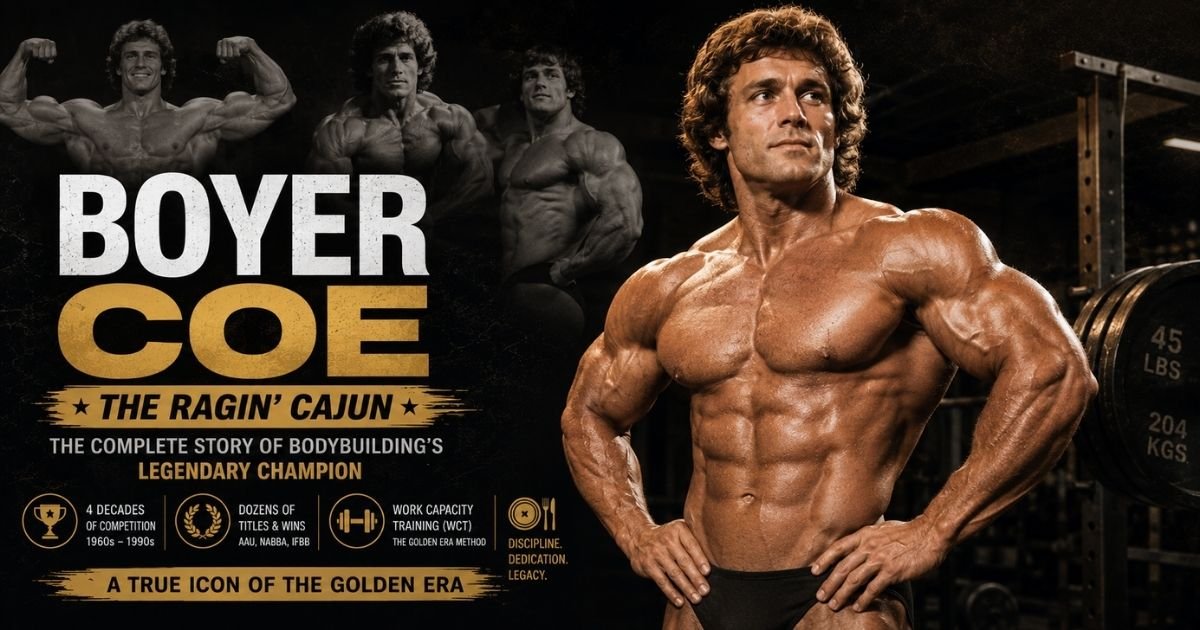
Boyer Coe stands as one of the most accomplished yet underappreciated names in bodybuilding world history. Competing across four decades — the 1960s, 70s, 80s, and 90s — Coe built a career that placed him alongside legends like Arnold Schwarzenegger, Sergio Oliva, Mike Mentzer, and Frank Zane. Known affectionately as “The Ragin’ Cajun,” Boyer Coe’s dedication to weight training and his relentless competitive drive earned him dozens of titles, making him a true fixture of bodybuilding’s Golden Era.
This article covers everything worth knowing about Boyer Coe: his complete competitive record, his training philosophy, his diet, the people who inspired him, and what lessons his decades-long career can offer lifters today.
Who Is Boyer Coe?
Boyer Coe is a former professional bodybuilder whose career spanned an extraordinary length of time compared to most of his peers. While many competitors from his era had a handful of active years, Coe remained competitive from the early 1960s all the way through the mid-1990s. His longevity, combined with a physique defined by symmetry, sharp conditioning, and classic proportions, earned him deep respect within the bodybuilding world, even though he never claimed the top spot at Mr. Olympia.
His nickname, “The Ragin’ Cajun,” reflects his Louisiana roots and the intensity he brought to every competition he entered. For fans of classic bodybuilding, Boyer Coe remains a benchmark example of consistency, discipline, and longevity in a sport known for burning out its competitors quickly.
Athlete Statistics
Here’s a snapshot of Boyer Coe’s key stats:
| Stat | Detail |
|---|---|
| Full Name | Boyer Coe |
| Weight | 215–225 lbs (93.0–102.1 kg) |
| Height | 5’9″ (175 cm) |
| Age | 80 |
| Date of Birth | August 18, 1946 |
| Nationality | American |
| Profession | Professional Bodybuilder |
| Alias | The Ragin’ Cajun |
| Era | 1960s, 1970s, 1980s, 1990s |
At 5’9″ and roughly 220 lbs in competition shape, Boyer Coe’s proportions reflected the classic bodybuilding aesthetic of his time — a balanced, symmetrical build rather than sheer mass alone.
Accomplishments
Few competitors can claim a résumé as extensive as Boyer Coe’s. His competitive record spans over three decades and includes wins at nearly every level of amateur and professional bodybuilding.
Competitions
Boyer Coe’s competition history includes an extraordinary number of placements across multiple federations, including the AAU, NABBA, WBBG, and IFBB. Some of his most notable results include:
- 1973 & 1975 NABBA Universe (Pro) — Overall Winner
- 1971 & 1969 NABBA/AAU Mr. America — Winner
- 1970 NABBA Mr. Universe — Winner
- 1971 IFBB Mr. International — Overall Winner
- 1969 AAU Junior Mr. America — Winner
- 1971–1975 WBBG World Championships — Winner (multiple years)
- 1981 IFBB Grand Prix World Cup — Winner
- 1981 IFBB Grand Prix Massachusetts — Winner
- 1981 IFBB Professional World Cup — Winner
- 1982 IFBB World Pro Championships — 2nd Place
- 1994 Masters Olympia — 3rd Place
- 1995 Masters Olympia — 10th Place
Beyond these headline results, Coe placed consistently well throughout the late 1970s and early 1980s, finishing in the top 5 at numerous Grand Prix events across the United States, Canada, and Europe.
Boyer Coe’s Major Titles: A Quick Reference
For readers wanting a simplified overview of his career-defining wins, here’s a condensed table of his most significant titles:
| Year | Title | Result |
|---|---|---|
| 1965 | Mr. Texas | Winner |
| 1969 | Junior Mr. America | Winner |
| 1970 | Mr. World / NABBA Mr. Universe | Winner |
| 1971 | Mr. America | Winner |
| 1973 | NABBA Universe (Pro) | Overall Winner |
| 1975 | WBBG World Championships | Winner |
| 1981 | IFBB Grand Prix World Cup | Winner |
This table highlights just how dominant Boyer Coe’s peak years truly were, with major wins spanning both amateur and professional ranks across multiple bodybuilding federations.
Biography
Boyer Coe’s rise from a small-town Louisiana kid to one of bodybuilding’s most respected competitors is a story of patience, self-education, and relentless consistency.
From Calisthenics to Bodybuilding
Boyer Coe was born and raised in Lake Charles, Louisiana, alongside his younger sister, Cindy. His interest in bodybuilding began remarkably early, around age 5, though his real understanding of how to build muscle didn’t develop until years later.
At first, Coe relied on calisthenics, believing bodyweight exercises alone could build the size he wanted. That changed after he read his first bodybuilding magazine, which introduced him to the concept of structured weight training. Shortly after, he acquired a basic pair of dumbbells and a barbell and began training in his family’s garage.
The results came quickly. By age 15, Boyer had developed a physique noticeable enough to earn attention among his peers, fueling even more motivation to continue training with weights. Eventually, he outgrew his home setup and joined a local gym in Lake Charles, marking the beginning of a more serious approach to his craft.
Start of Competitive Career
In the summer of 1962, Boyer entered his first bodybuilding contest, the Teen Mr. South competition in Alabama. With no prior stage experience, he was pleasantly surprised to place among the top 5 competitors — a strong debut that encouraged him to keep competing locally throughout the summer.
His first major title came in 1964 at the AAU Mr. New Orleans, won just three days before his high school graduation. Six months later, he added another regional title, Mr. Hercules Southwest, to his growing résumé.
After finishing high school, Boyer met trainer Lloyd “Red” Lerille, who played a critical role in refining his physique and preparing him for the elite levels of the IFBB and NABBA. During this same period, Coe pursued degrees in psychology and management at the University of Southwestern Louisiana, balancing academics with an increasingly demanding training schedule.
Dominance Throughout the 70s and 80s
Within a few years, Boyer Coe secured two major national titles: the 1966 Teen Mr. America, and the 1968 Junior Mr. America title, which he won on his 22nd birthday. These wins set the stage for what would become the most dominant stretch of his career.
Throughout the 1970s and 80s, Coe’s reputation in the bodybuilding world grew substantially. During this period, he claimed 18 titles, including the 1970 NABBA Mr. Universe, the 1971 Mr. America, the 1975 WBBG World Championships, and multiple IFBB Grand Prix victories across 1981, including wins in Massachusetts and the Grand Prix World Cup.
Coe also placed consistently high at Mr. Olympia, finishing in the top 4 overall during 1977, 1978, and 1980 — an impressive feat considering the level of competition he faced from some of the greatest bodybuilders in history. These results cemented Boyer Coe as one of the most accomplished and respected competitors of his generation.
Later Years
Following his peak years, Boyer Coe stepped away from competition for an extended period. He returned in 1994, competing in what would be his final two professional shows: the 1994 and 1995 Masters Olympia, placing 3rd and 10th respectively.
After retiring from professional competition, Coe remained closely connected to the sport. He co-hosted a fitness and bodybuilding television show during the 1990s, later opening his own health food store and eventually a gym in New Orleans — extending his influence on the bodybuilding world well beyond his competitive years.
Training
Boyer Coe’s approach to training reflected the disciplined, form-focused philosophy common among Golden Era bodybuilders. As he explained:
“I have always believed in a complete range of motion in all exercises, full contraction and full extension. That is the best way to prevent an injury. I see a lot of guys doing partial reps and really using a lot of momentum in their exercises – their joints just won’t last doing it this way.”
Always Going Strong
During his competitive years, Boyer would wake at 5 a.m. to train, often pushing himself through intense sessions before starting the rest of his day. Remarkably, this discipline never fully faded. Even long after retiring from professional competition, Coe continues training in the gym up to five times per week.
While the intensity has naturally decreased with age, Coe has said he still carries “that burning desire” that drove his early career. As he puts it simply: “I always simply trained hard and put forth the effort” — a mindset that has clearly outlasted his competitive years.
Work Capacity Training
Boyer Coe’s signature training plan was designed specifically to achieve the classic “old-school” 70s physique: a small waist, wide back, defined abs, broad shoulders and arms, and full, well-developed pecs.
He called this system Work Capacity Training (WCT) — a modified version of High-Intensity Training built around pyramid sets and short rest periods. A typical WCT session followed this structure:
- Warm-up on the day’s primary exercise
- Progressive loading — increasing weight each set until reaching a load he could barely complete for 12 reps
- Strict form with a slow, controlled negative on each rep
- 60-second rest periods between sets
- Weight reduction of 5–10 lbs on each subsequent set
This pyramid-style structure allowed Coe to maximize muscle fiber recruitment while minimizing joint stress, aligning closely with his stated philosophy on injury prevention.
Boyer’s Workout Plan
Coe’s weekly training split was straightforward and repeatable:
| Day | Focus |
|---|---|
| Monday | Chest and Back |
| Tuesday | Shoulders and Arms |
| Wednesday | Legs |
| Thursday | Chest and Back |
| Friday | Shoulders and Arms |
| Saturday | Legs |
| Sunday | Rest |
This structure allowed each muscle group to be trained twice per week, a frequency that supported both strength and the size development that defined his competition-ready physique.
How to Apply Work Capacity Training Today
Modern lifters can absolutely apply Boyer Coe’s WCT principles to their own training plan:
- Start light and build up — use your warm-up sets to prepare joints and muscles before reaching your working weight
- Aim for 12 reps on your top set, then reduce the weight slightly for each subsequent set
- Rest for 60 seconds between sets to maintain intensity without full recovery
- Focus on controlled negatives rather than rushing through reps
- Train each muscle group twice weekly using an upper/lower or push/pull structure similar to Coe’s original split
This approach remains just as relevant today as it was during bodybuilding’s Golden Era, offering a proven method for building size while protecting long-term joint health.
Nutrition
Like many bodybuilding icons of the Golden Era, Boyer Coe built his diet around high protein and saturated fat intake. Raw eggs served as one of his primary protein and fat sources, supplemented by regular servings of chicken, fish, beef, and pork.
During his off-season, Coe consumed higher amounts of carbohydrates to support muscle growth, gradually reducing carb intake as he approached his cutting phases before competition. He also relied on homemade protein shakes, blending milk powder, raw eggs, oats, and other nutrient-dense ingredients — a far cry from the pre-packaged supplements common today, but effective for the era’s training demands.
Boyer Coe’s Physique in Context: The Golden Era Aesthetic
Boyer Coe’s physique fits squarely within what fans now call bodybuilding’s “Golden Era” — a period defined by symmetry, proportion, and aesthetics over sheer mass. Unlike the significantly larger physiques that would come to dominate the sport decades later, Coe and his contemporaries, including Schwarzenegger, Zane, and Oliva, prioritized a balanced, classically sculpted look.
This aesthetic emphasized a small waist, wide shoulders, and precise muscle definition — qualities clearly reflected in Coe’s competition results and his own stated training goals. His consistent top-4 finishes at Mr. Olympia during 1977, 1978, and 1980 place him firmly among the era’s most respected physiques, even without an Olympia title to his name.
Idols and Influences
Boyer Coe’s primary inspirations in bodybuilding were Bill Pearl and Sergio Oliva, two of the sport’s most respected figures during his formative years. Beyond these idols, Coe credited his close friend and trainer, Red Lerille, with playing a major role in his development, particularly with posing and technique refinement.
Speaking about their relationship, Coe said: “A man I am truly proud to call a friend.” This mentorship proved essential in helping Coe transition from a promising amateur into a genuine professional contender within the competitive bodybuilding world.
Where Is Boyer Coe Now?
Decades after his final professional competition, Boyer Coe remains a respected figure within the bodybuilding community. His name continues to surface in discussions about the sport’s Golden Era, often alongside contemporaries like Schwarzenegger and Zane. Longtime fans and fellow competitors regularly credit Coe’s consistency, technique, and longevity as qualities that set him apart from many of his peers.
What We Can Learn From Boyer Coe
Boyer Coe’s journey began humbly, training with basic dumbbells and a barbell in his family’s garage. From there, he progressed into serious weight training, eventually competing on some of the biggest stages in the bodybuilding world for over three decades.
What his story teaches us is simple: everyone starts somewhere, even the greats. Boyer Coe didn’t begin with elite genetics or professional coaching — he built his career step by step, competition by competition, title by title. His path reminds us that small, consistent steps, sustained over years rather than months, are often what separate lasting success from short-lived achievement.
Frequently Asked Questions About Boyer Coe
How old is Boyer Coe? He was born in 1946, making him 80.
Why is Boyer Coe called “The Ragin’ Cajun”? It reflects his Louisiana roots and intensity.
Did Boyer Coe ever win Mr. Olympia? No, his best finish was top 4.
What was Boyer Coe’s training philosophy? Full range of motion with strict, controlled form.
Who inspired Boyer Coe’s bodybuilding career? Bill Pearl and Sergio Oliva were his idols.

Hi, I’m John Wick, the admin at Magazineaura.com. I make measurements simple and easy to understand, from bed sizes to everyday length conversions. Clear guides. Accurate dimensions. No confusion.