When you grab a Monster can from the fridge, you’re not just picking a drink. You’re picking a specific can size, a set caffeine dose, and a feel in your hand that changes how the whole experience plays out.
Every Monster Energy can on the market has its own can dimensions, its own volume, and its own role to play in your day.
This guide breaks down every size, from the smallest mini can to the largest resealable format, so you know exactly what you’re reaching for.
What This Guide Helps You Choose
Picking the right Monster can size isn’t just about how thirsty you are. It’s about how the can fits in your hand, how long the boost lasts, and how much caffeine you’re actually taking in.
This guide walks through every can dimensions detail for each Monster Energy variant sold in the U.S., so you can compare can size options at a glance instead of guessing on the shelf.
Extra Details That Matter
Beyond the numbers on a tape measure, can size changes what’s inside the can. A smaller Monster can means less sugar and a lighter caffeine content.
A larger one means a bigger serving built for longer stretches of activity. Knowing these details in advance means you’re never caught off guard by a caffeine spike or an unexpectedly heavy sugar count.
Why Size Impacts Your Daily Experience
Think of choosing a Monster can size the same way you’d choose a water bottle for the gym versus a thermos for a road trip.
A short commute calls for something small and quick. A long gaming session or an all-day shift calls for something that lasts. The right size keeps your energy curve steady instead of spiking hard and crashing an hour later.
Inside the World of Monster Energy
Monster Energy built its identity on a bold black-and-green can and a sharp claw “M” logo that’s instantly recognizable on any store shelf. What started as a challenger energy drink grew into one of the most dominant names in the energy beverage category, fueled by a formula of caffeine, taurine, and B-vitamins designed to support focus and stamina.
The Monster brand didn’t just sell a beverage — it sold a lifestyle. Sponsorships across motocross, esports, and music festivals cemented Monster drinks as the go-to choice for people who live fast and push hard.
Today, the brand’s lineup spans far beyond the original can, covering coffee blends, hydration bottles, and zero-sugar lines, each with its own can size and purpose.
Monster Can Size Table
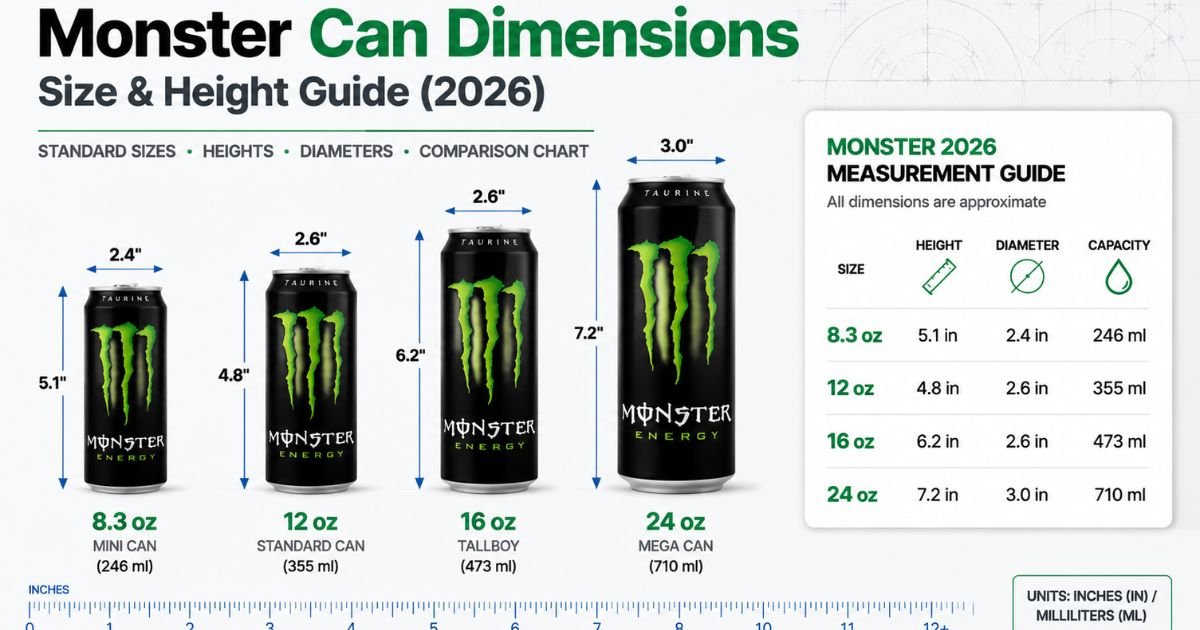
Here’s a full breakdown of the major Monster can variants, their volume, their can dimensions, and their caffeine content. Use this table as a fast reference before you commit to a size.
| Monster Variant | Volume (oz / ml) | Height x Diameter (in / cm) | Caffeine (mg) |
|---|---|---|---|
| Mini Can | 8.3 oz / 246 ml | ~5.1–5.5″ / 13–14 cm x 2.4″ / 6.1 cm | 80–100 mg |
| 12 oz Can | 12 oz / 355 ml | 4.8″ / 122 mm x 2.6″ / 66 mm | 120–140 mg |
| Java Monster | 15–15.5 oz / 444–458 ml | ~6″ / 15.2 cm x 2.6″ / 6.6 cm | 150–200 mg |
| Standard Monster | 16 oz / 473 ml | 6.2″ / 15.7 cm x 2.6″ / 6.6 cm | 160 mg |
| Mega Can | 24 oz / 710 ml | 7.2″ / 18.4 cm x 3″ / 7.6 cm | 240 mg |
| Monster Hydro | 20 oz / 550 ml | 7.5″ / 19 cm x 2.8″ / 7 cm | Varies |
Standard Monster Can Size
The standard Monster can in the U.S. is the 16 oz (473 ml) format — often nicknamed the tallboy can because of its taller, slimmer profile compared to a typical soda can. It’s the size most people picture when they think of a Monster can, and it’s the one stocked on nearly every convenience store shelf in the country.
- Volume: 16 fluid ounces (473 milliliters)
- Dimensions: approximately 6.2 inches tall (15.7 cm) with a 2.6-inch diameter (6.6 cm)
- Caffeine content: roughly 160 mg per can of Monster Original
- Why this size? It delivers a full serving for people who want a strong, lasting boost, while still fitting most cup holders and fridge door shelves
For retailers and packaging designers, the standard Monster footprint is the benchmark size — shelf spacing, cooler slots, and display racks are frequently built around this exact 16 oz can profile.
Variant Monster Energy Can Sizes Explained
Not every Monster Energy product ships in the same container. Here’s how each size stacks up.
8.3 oz (246 ml) Mini Can
The mini can is the smallest Monster can on shelves, typically reserved for promotional runs, zero-sugar Ultra launches, or travel-friendly multipacks.
- Purpose: A lighter serving for people who want a smaller dose or a limited-edition flavor test
- Dimensions: Height sits around 5 inches, with a diameter close to standard can widths
- Caffeine: Lower than the standard size, though availability shifts by market
- Use case: Quick energy without committing to a full-size energy drink
12 oz (355 ml) Can
This size follows the classic beverage can spec — 122 mm tall and about 66 mm in diameter, matching industry standards used across the broader canned drink market.
- Dimensions: Standard 12 oz aluminum can shape
- Caffeine & Nutrition: Slightly lower volume brings a slightly lower caffeine amount and sugar count
- Use case: A middle-ground option for people who want less than a full 16 oz can but more than a mini
444 – 458 ml Java Monster & Coffee + Energy
Java Monster blends coffee flavor with an energy drink kick, packaged in a 15 to 15.5 oz can that’s slightly shorter and wider than the standard format.
- The Java Monster line was built specifically to combine a coffeehouse taste with functional caffeine
- Caffeine content in this line often ranges from 150 to 200 mg depending on flavor
- It satisfies cravings for both a coffee beverage and an energy boost in one can
16 oz / 473 ml (Standard/Tallboy)
This is the size covered above as the standard Monster — the most widely distributed can size in the U.S. market. It remains the reference point every other variant gets compared against, whether by volume, can dimensions, or caffeine levels.
24 oz / 710 ml — Mega/Resealable Large Can
The Mega Can is built for people who don’t want to crack open a second Monster can halfway through a long session.
- Purpose: A bigger serving designed for extended stretches — long drives, gaming marathons, or double shifts
- Caffeine: Around 240 mg, following a similar per-ounce ratio to the standard size
- Feature: Many Mega Cans include a resealable screw-top lid, a functional upgrade over the standard pull-tab
- Use case: Fewer trips back to the fridge, more sustained energy
Bottle Variants — Monster Hydro & Others
Monster Hydro breaks from the traditional aluminum can format entirely, packaging its formula in a resealable plastic bottle instead.
- Packaging matters: Bottle shape, wide mouth opening, and reusability set this line apart from a typical beverage can
- Use case: For anyone who wants a more “sports hydration” feel rather than a classic energy can experience
Other Lines & Regional Sizes
- Reign Total Body Fuel, a sister brand under the same parent company, commonly ships in the same 16 oz format
- Special collaborations and collector editions sometimes use unique can shapes or limited packaging
- Certain countries offer a 500 ml format with around 160 mg caffeine due to local regulations
Precise Dimensions, Tolerance & Why Sizes Vary
Even a well-documented standard Monster can — listed at 6.2 inches tall with a 2.6-inch diameter — isn’t manufactured with zero variation. Industry spec sheets for a 473 ml beverage can generally list a height near 157 mm and a diameter near 66 mm, but small shifts are normal across production runs.
Several factors explain why:
- Material tolerances in aluminum manufacturing allow tiny variances between batches
- Regional manufacturing equipment may adjust dimensions slightly depending on the facility
- Branding decisions sometimes call for a taller, slimmer shape versus a shorter, wider one
- Designers and retailers should always confirm exact SKU measurements rather than assuming one size applies universally across every market
Nutrition & Caffeine by Size
The can itself only tells half the story. What’s packed inside matters just as much when comparing Monster can options.
Caffeine Content
A standard 16 oz can delivers about 160 mg of caffeine, working out to roughly 10 mg per fluid ounce, or 33.8 mg per 100 ml, in the U.S. version. Lighter lines like Ultra or Lo-Carb typically run slightly under that, closer to 140–155 mg. Even imported formats, like the 500 ml international can, tend to hold onto that same 160 mg benchmark.
Nutrition Facts (Regular Monster 16 oz)
Typical nutrition facts for the U.S. Monster Original in its 16 oz format include:
- Calories: approximately 210 kilocalories
- Sugar: around 54 grams
- Carbohydrates: about 54 grams
- Sodium: roughly 370 milligrams (varies by batch)
- Ingredients: carbonated water, sucrose, glucose, citric acid, taurine, L-carnitine, panax ginseng root extract, caffeine, inositol, guarana seed extract, and B-vitamins
Size vs Nutrition/Caffeine
- The 8.3 oz mini can holds roughly 80–90 mg of caffeine, about half the calories of a 16 oz can, with sugar near 25–30 grams
- The 12 oz size carries about 120–130 mg caffeine, 150 calories, and 35–40 grams of sugar
- The 15–15.5 oz Java Monster range runs 140–180 mg caffeine, around 200 calories, and 45–50 grams of sugar
- The standard Monster 16 oz can includes about 160 mg caffeine, 210 calories, and 54 grams of sugar
- The 24 oz Mega can reaches about 240 mg caffeine, 315 calories, and 80 grams of sugar
Always check the local label, since region and flavor can shift these numbers.
Packaging & Functional Differences That Matter
The can size you pick isn’t only about volume — packaging format changes how you actually use the product day to day.
- Can vs. bottle: An aluminum energy can chills faster and travels easier, while a Monster Hydro bottle offers a resealable cap and a more “sports drink” feel
- Tall/slim vs. short/wide: Taller, slimmer cans slide into car cup holders and backpack side pockets more easily
- Resealable large format: The 24 oz Mega can is convenient for long sessions, but once opened, carbonation fades faster than in a sealed can
- Shelf and display: The 16 oz can fits most standard retail shelving, while mini or oversized formats often need custom display setups
- Material and recycling: Aluminum Monster containers are widely recyclable, while plastic bottle formats require separate disposal streams
Regional Availability & Naming Difference
Can dimensions and naming conventions shift depending on where you’re buying.
- In Europe and Australia, the 500 ml size (about 16.9 oz) is the common standard size, carrying roughly 160 mg caffeine
- Some markets stock 12 oz or 8.3 oz formats more heavily, often tied to local pricing or promotional strategy
- Naming conventions differ too — “Mega Monster” usually points to the 24 oz can, “Java Monster” refers to the 15–15.5 oz coffee blend, and “Hydro” points to the 20 oz bottle line
- Always double-check local labeling, since ounce-to-milliliter conversions, caffeine per serving, and sugar content can all shift between countries
Buying & Storage Tips
- Match size to need: Go smaller for a short session, larger for extended activity
- Watch your caffeine sensitivity: Even the “standard Monster” 16 oz can delivers a meaningful 160 mg
- Check the fit: If you’re carrying a can in a backpack or cup holder, measure against the known 6.2-inch height and 2.6-inch diameter
- Chill before drinking: Cans cool faster than bottles, and taste and carbonation both peak when cold
- Store upright and cool: Heat breaks down carbonation, so keep cans out of direct sunlight
- Read the label: Regional variants may list different sugar or caffeine amount figures than the U.S. spec
Use Cases for Each Size
- 8.3 oz mini: A fast boost before a short workout or morning commute
- 12 oz: A moderate dose for a daytime pick-me-up without the full 16 oz can volume
- 15–15.5 oz Java line: Coffee flavor plus an energy boost during long work or study sessions
- 16 oz standard: The everyday choice, built for a general, reliable caffeine content boost
- 24 oz Mega: Built for extended events like gaming marathons or long drives
- Hydro bottle: Best when you want a “water-style” sports hydration feel over a traditional can
Common Myths and Clarifications
- Myth: All Monster cans are 16 oz. False — the lineup spans 8.3 oz, 12 oz, 15–15.5 oz, 24 oz, and bottle formats depending on the region
- Myth: A bigger can always means the same caffeine per ounce. Usually true, but specialty editions can differ, so the label is worth a glance
- Myth: Every Monster can has 210 calories. That figure applies only to the standard sugared 16 oz version — zero-sugar and Ultra lines run much lower
- Clarification: Height and diameter are well documented — the 16 oz can measures roughly 6.2 inches (15.7 cm) tall with a 2.6-inch (6.6 cm) diameter, confirmed across independent measurements and industry spec sheets
Case Study: Monster Energy from Launch to Global Dominance
Monster Energy’s rise from a regional newcomer to a global energy drink leader offers a clear lesson in how packaging and branding decisions shape long-term success.
Background:
Monster Energy launched in April 2002 out of Corona, California, under Monster Beverage Corporation, then known as Hansen Natural Company. From day one, the brand aimed squarely at young, active consumers looking for bold flavor and a strong energy kick.
Challenge:
The energy beverage category was already crowded, with Red Bull holding a dominant position. Monster needed a way to stand apart while building loyalty with an adventurous, younger audience that competitors hadn’t fully captured yet.
Strategy:
- Launched with a 16 oz can — noticeably larger than most rivals, offering more perceived value per purchase
- Poured resources into extreme sports sponsorships, concerts, and lifestyle-driven marketing campaigns
- Expanded the lineup with Mini, 12 oz, Java Monster, Mega, and Monster Hydro variants to serve different consumer needs
Results:
- By 2005, Monster had built a strong, loyal base across the U.S.
- By 2010, the brand expanded into Europe, Latin America, and Asia
- As of 2026, Monster remains a market leader in the U.S. with a diverse product line and global brand recognition
“Differentiation doesn’t always come from the formula — sometimes it comes from the can in your hand.” This idea captures exactly how Monster used can size as a competitive edge from day one.
Key Takeaways:
- Standing out through can dimensions and packaging can create a lasting competitive edge
- Lifestyle-driven marketing builds deeper brand loyalty than product features alone
- A diversified lineup of sizes and flavors supports long-term, sustainable growth
Fun Facts About Monster Cans
- The first Monster Energy drink launched in 2002 under Hansen Natural Company, now Monster Beverage Corporation
- The claw logo is designed to represent the burst of energy felt after drinking
- The original 16 oz can stood out at launch by offering roughly double the size of most competing energy drink cans
FAQs
What is the standard Monster can size?
Sixteen ounces (473 ml) is the standard Monster can size nationwide.
How much caffeine is in a Monster can?
A standard 16 oz Monster can contains about 160mg caffeine.
Does Monster have smaller cans?
Yes, Monster offers 8.3 oz mini cans and 12 oz options.
Are all Monster flavors the same in caffeine content?
No, Ultra and Lo-Carb variants contain slightly less caffeine typically.
How many calories are in a Monster can?
A regular 16 oz Monster has about 210 calories total.
Closing Practical Takeaway
Choosing a Monster can comes down to more than grabbing whatever’s closest in the cooler. Size shapes volume, caffeine content, calories, and how the can actually fits your day. Go with the standard Monster 16 oz can and you’re working with about 160 mg caffeine, 210 calories, and a 6.2-inch height. Pick a variant instead, and the label will tell you exactly what’s different.
For designers, retailers, and everyday drinkers alike, understanding Monster can dimensions means shopping smarter, storing smarter, and picking the size that actually matches your pace.
Things That Are 10 Inches Long And 16 Inches Long And 40 Inches Long And 15 Inches Long And 12 Inches Long And How Far Is 20 Feet Visually? And Soda Can Dimensions

Hi, I’m John Wick, the admin at Magazineaura.com. I make measurements simple and easy to understand, from bed sizes to everyday length conversions. Clear guides. Accurate dimensions. No confusion.